
The construction industry in the United Arab Emirates is quickly embracing modern standards of digital delivery, which makes complying with ISO 19650 UAE an important part of any contemporary BIM project. The ISO 19650 is a global system that organisations can use to improve their management of information, how well they work together, and how efficiently each organisation delivers a project over its asset lifecycle. In this guide, Designheed UAE will provide you with insights on how to achieve good practices, steps, and requirements to comply with by 2026.
What is ISO 19650?
ISO 19650 in the United Arab Emirates is the use of ISO 19650 information management BIM UAE standards through the use of BIM in the construction environment.
Developed by ISO to manage the overall lifecycle of the project through a structured approach to create, store, share, and manage all project information over its life cycle (design, construction, operations, and maintenance), and provides a significant benefit in improving:
- Collaboration between all stakeholders
- Standardisation of information management BIM UAE processes
- Reduction of project risks
- Enhance the quality and consistency of project information
- Support the management of digital assets
- Increase project delivery
As the demand from both the public and private sectors in the UAE for improved project outcomes and digital transparency increases, so does the need for all UAE projects to comply with ISO 19650.
Importance of ISO 19650 Compliance In The UAE
Construction in the UAE has adopted digital technologies to help create advanced new developments and smart infrastructure.
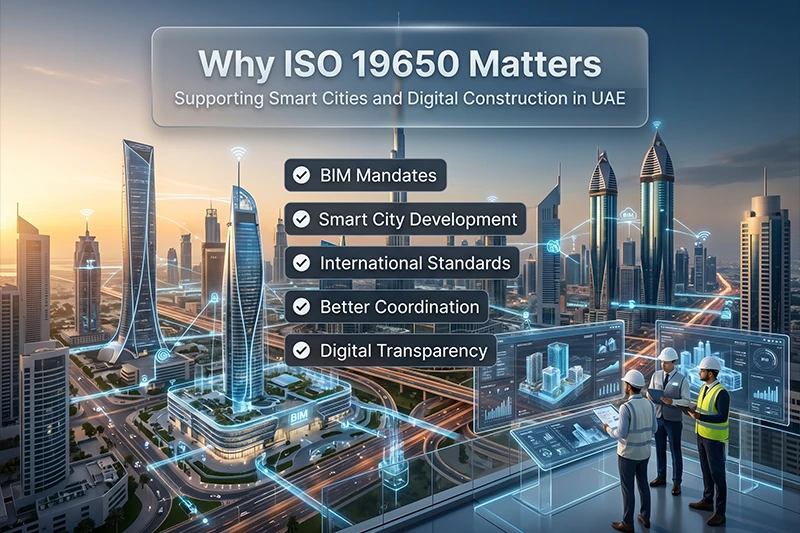
There are several reasons for implementing BIM ISO 19650 compliance in Dubai:
- Growth of BIM Mandates - New major construction projects rely on a combination of standardised processes for managing BIM information flows.
- Development of Smart Cities - Digital asset information is essential for the ongoing operation and maintenance of facilities as they continue to develop.
- Growing Expectation of International Best Practices - Global investors and stakeholders of the project are increasingly expecting internationally recognised BIM best practices.
- Improving Ability To Coordinate Projects - The implementation of ISO 19650 allows for a streamlined flow of information, thereby improving collaborative multidisciplinary efforts.
By connecting with Designheed UAE, Your Company Will Have Access To Structured Implementation Strategies That Are In Alignment With Local Project Needs And International Standardization.

Key Principles of ISO 19650
To comply with the ISO 19650 Standard, you must understand the main principles related to the management of information, through BIM, across an asset's lifecycle.
Information Management - Information management (IM), using BIM, will be referenced as a principal process within the management of the asset across each stage of the asset lifecycle.
Information must be managed through the principal procedures of:
- Creation of information
- Approval of information
- Sharing of information
- Storage of information
- Security of information
- Maintaining information
Collaborative Working - All people involved in the project have access to the same information and can therefore work together, ensuring that the information produced and used is accurate and accessible.
Defined Responsibilities - All parties involved in managing information during the project will have clearly defined roles and responsibilities when it comes to the management of information.
Standardised Processes - All organisations should define and establish repeatable processes/workflows that will enable them to deliver BIM efficiently.
Understanding EIR BIM UAE
One of the most important components of ISO 19650 is the EIR BIM UAE, or Employer's Information Requirements. The EIR BIM UAE can be considered one of the major aspects of ISO 19650. The EIR or Employers' Information Requirement states –
The EIR contains:
- Information deliverables
- BIM Objectives
- Data Exchange Requirements
- Asset Information Expectations
- Creation of Standardised Project Information
This document acts as a base for the successful delivery of projects by allowing all members of the Project Team to understand what the client's information requirements are to successfully execute the project using BIM.
To ensure there are clear and comprehensive EIR documents available for use, Designheed UAE assists clients in creating the necessary documentation to successfully deliver their projects using BIM.
CDE ISO 19650 Dubai: A Basis for Collaborative Digital Work
An essential aspect of ISO 19650 is the Common Data Environment (CDE). The CDE ISO 19650 Dubai framework offers a centralised location for stores, managing and sharing project data.
A compliant CDE would provide:
- Tracking of versions
- Document approvals
- Management of workflow
- Control of information security
- Audit trails
- Access permissions
Establishing a properly configured CDE will minimise information duplication by providing all stakeholders with access to the latest, approved data.
Designheed UAE assists organisations in establishing workflows for their CDEs to meet the requirements of ISO 19650 and the needs specific to their particular project.
The Alignment of UAE BIM Standard With ISO 19650
Several companies use internal procedures for building information modelling, however, that internal standard must be aligned with an internationally accepted BIM standard (UAE BIM Standard or ISO 19650) for construction projects to be compliant with certification requirements.
The following areas need to be aligned:
- Naming Convention - Using the same name/structure to save files will make it easier to find and manage files.
- Classification System - Having a uniform classification system allows data to be consistent between disciplines.
- Procedures for Exchanging Information - The team has to have formal procedures for approving and exchanging information.
- Quality Control Process - Having regular checks/audits and validating the data will maintain its accuracy.
Organisations should routinely audit their BIM standards in the UAE and compliance with the UAE BIM Standard and ISO 19650 to maintain compliance.
UAE ISO 19650 Implementation: Step-by-Step Strategy
Successful ISO 19650 implementation in the UAE requires a structured approach.
Step One: Evaluate the level of maturity for existing BIM practices, technology, and the team's current capabilities.
Step Two: Develop Information Management Frameworks consists of creating the procedures necessary to align with sections of the ISO 19650 Standard.
Step Three: Define Employer Information Requirements is the process by which project-specific information requirements are established through a detailed set of EIR documentation.
Step Four: Establish a Common Data Environment whereby an appropriate compliant CDE platform is implemented, which includes clearly defined project workflows.
Step Five: Create a BIM execution plan in the UAE for each project that satisfies all information management-related expectations.
Step Six: Train all project team members/stakeholders in ISO 19650 processes.
Step Seven: Monitor compliance through regular audits to ensure conformity to established standards.
Designheed UAE assists organisations through all stages of implementation to reduce risks and accelerate the achievement of compliance.
Conclusion
As businesses are using BIM more often in the UAE construction industry, meeting ISO 19650 standards is becoming a priority for both project owners and delivery teams.
The organisations that set up structured processes for managing information, provide a compliant common data environment (CDE), create an effective BIM execution plan in the UAE, and have standardised BIM practices are likely to be positioned for successful delivery of their projects by 2026 and beyond.
Designheed UAE assists companies to better understand how to meet ISO 19650 requirements to develop more collaborative work relationships, mitigate risks on the project, and harness the real potential of digital construction.
Frequently Asked Questions
Q: How is ISO 19650 being utilised in the UAE?
A: ISO 19650: Improves collaboration, standardises (unifies) how information will be managed & enables & supports the delivery of digitally-based projects within the construction industry.
Q: What’s EIR in BIM?
A: Employer’s Information Requirements (EIR) defines the deliverable type and associated BIM expectations for a given project.
Q: What is a BIM Execution Plan?
A: A BIM Execution Plan (BEP) describes how the Project Teams will satisfy the BIM and Information Management requirements of a project.
Q: What’s a Common Data Environment (CDE)?
A: The CDE is your centralised location for all Project Information to be managed, stored, shared and controlled during all phases of a Project Life Cycle.
Q: What does an ISO 19650 consultant do?
A: An ISO 19650 consultant UAE assists organisations in establishing compliant BIM processes; developing (establishing) a Governance Framework for their BIM Processes; implementing the Information Management Standards of ISO 19650.
Q: Is ISO 19650 mandatory for projects in the UAE?
A: ISO 19650 is not universally mandated, but increasingly various Government Entities & major private sector entities require ISO 19650-compliant BIM Processes for their respective Projects.