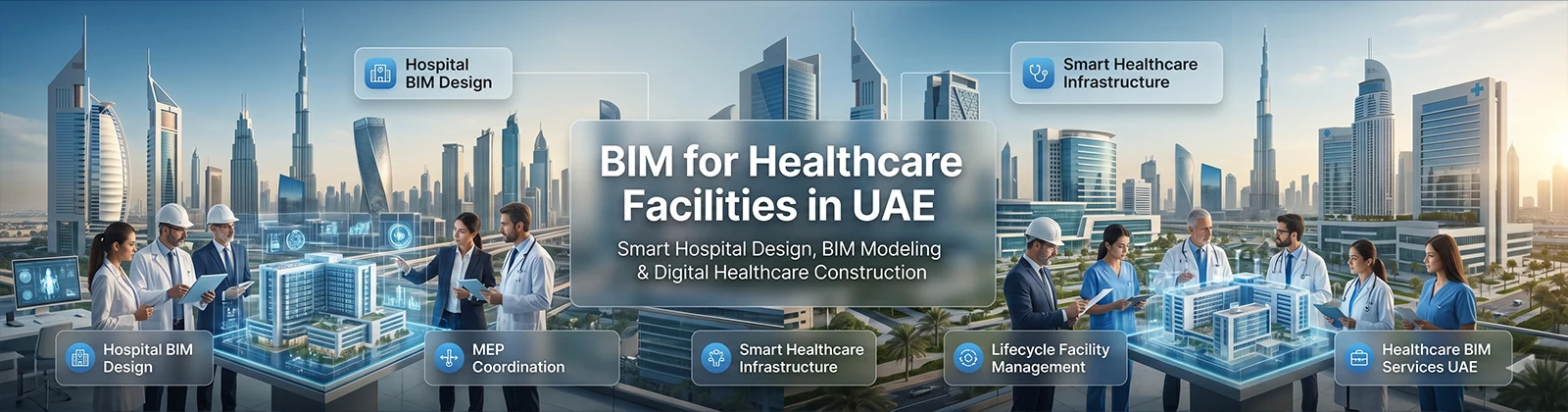
The UAE health care sector is rapidly changing, mostly because of advanced tech and fresh construction methods. Building Information Modeling (BIM) is really shifting how hospitals get designed and even how they’re operated, for example, from BIM hospital design in UAE, to hospital BIM modeling in Abu Dhabi, which makes it easier to keep projects cost-effective, efficient, and well-managed, or at least much more controlled. In this type of project, developers, contractors, and facility managers can use BIM’s full capability, especially when they get support from Designheed UAE, a well-known provider offering specialized healthcare BIM services.
What is BIM and why does it matter in Healthcare
Building Information Modeling (BIM) works like a digital tool that shows the full physical and operational specifics of a building, kind of all in one place. BIM enables users to work together through its 3D system, which combines all building elements, including architectural, structural, mechanical, and electrical components into one comprehensive design system.
The complex design requirements of hospital facilities make Building Information Modeling (BIM) essential for healthcare facilities. The hospital needs precise design coordination together with exact mechanical and medical system integration, which must meet its strict regulatory requirements. The adoption of Building Information Modeling (BIM) in healthcare facilities, and also in hospital design projects across Dubai , delivers several key benefits really, including:
3D models that accurately represent essential hospital systems
- Better teamwork among different professional groups
- Fewer design mistakes that lead to construction problems
- More efficient building maintenance operations after construction ends
Key Applications of BIM in Healthcare Facilities
UAE developers are using BIM modeling in healthcare UAE to create sustainable healthcare infrastructure that operates efficiently. Some key applications include:
1. Hospital Design & Layout Optimization - Architects use BIM hospital design in the UAE to create models that show how patients will move through the hospital, how emergency workers will evacuate patients, and how the hospital will function. Smart design simulations improve patient experience and help reduce bottlenecks in high-traffic areas like emergency wards and outpatient departments, and operating theaters.
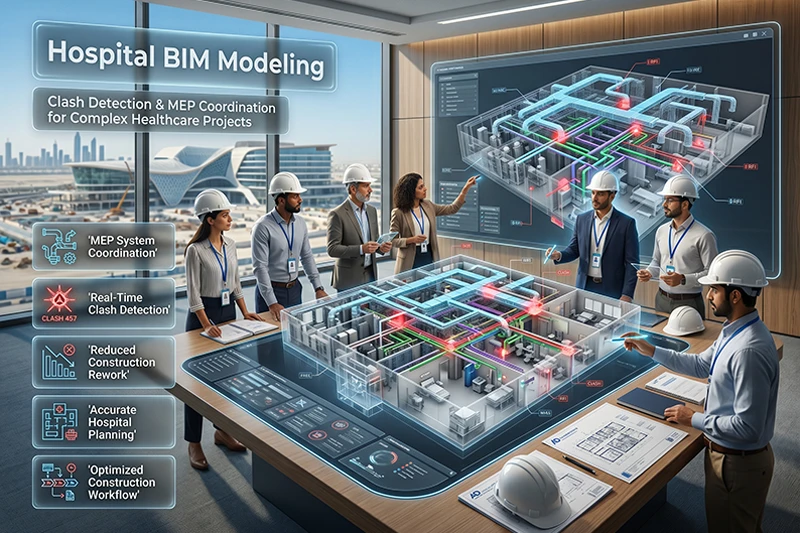
2. Construction Planning & Clash Detection - The construction process in healthcare projects faces its biggest challenge through the need to control MEP systems, which include Mechanical systems, Electrical systems, and Plumbing systems. BIM enables teams to perform precise coordination tasks, which lead to successful hospital BIM modeling in Abu Dhabi operations. This process leads to decreased construction work and time savings, and it results in lower overall expenses.
3. Facility Management & Lifecycle Planning - BIM offers essential support to hospital facilities management activities throughout their entire operational lifecycle. The models can combine actual data from equipment maintenance records, room usage patterns, and compliance timetable information. Healthcare BIM services in the UAE provide administrators with actionable insights for predictive maintenance and energy optimization.
4. Smart Hospital Development - The UAE currently experiences the emergence of smart hospitals, which combine IoT devices with their automated systems and digital patient management capabilities. The design process of Smart Hospital BIM UAE utilizes BIM technology, which enables designers to create hospital layouts that seamlessly combine all required technological systems.
5. Cost Estimation & Project Visualization - BIM provides healthcare projects with real-time cost estimation capabilities that decrease financial risks in their execution. The developers use 3D models to create construction sequences which they use to share project information with their stakeholders.
Benefits of BIM for Healthcare Facilities in the UAE
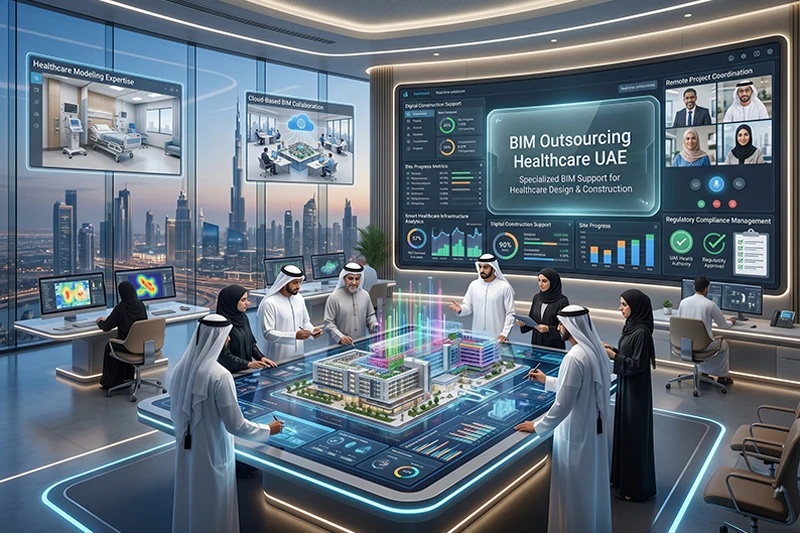
The implementation of BIM in healthcare facilities throughout Abu Dhabi and other cities in the UAE has improved the methods that hospitals use to develop their designs and handle their building processes and operational upkeep. The system provides multiple advantages, which include:
- Enhanced Collaboration - BIM establishes a cooperative environment that enables architects, engineers, consultants, and contractors to work together. The system uses cloud-based platforms to enable all stakeholders to view the most recent models, which helps eliminate miscommunication while creating a unified model that all parties can trust.
- Risk Mitigation - The construction of healthcare facilities requires builders to follow various intricate safety regulations. BIM technology allows teams to detect design errors before they become construction problems, which helps maintain compliance with UAE healthcare regulations.
- Sustainability & Energy Efficiency - Developers use BIM systems to create energy-performance models, which help them design efficient HVAC systems, and also implement sustainable building methods, that move along the UAE’s green building aims.
- Faster Project Delivery - The system uses clash detection together with automated documentation and detailed sequencing to speed up project completion times. This requirement for speed becomes especially critical in cities that experience rapid growth, such as Dubai, Abu Dhabi, and Sharjah.
- Post-Construction Benefits - BIM models function as digital replicas of healthcare facilities, which offer continuous assistance for building maintenance, equipment updates, and facility enhancements. The healthcare BIM services in Sharjah and other areas use this system for managing the entire lifecycle of their projects.
BIM Implementation Strategies for UAE Healthcare Projects
The developers of healthcare facilities in the UAE should use these strategies when they want to implement BIM in their projects.
- Engage Experienced BIM Consultants: The hospital team should work together with Designheed UAE to develop their BIM model and construction methods.
- Adopt Cloud-Based BIM Platforms: The organization should use cloud-based BIM platforms, which enable all stakeholders to work together from different locations.
- Create Standardized BIM Guidelines: The organization must establish BIM guidelines that include data standards and naming conventions that meet UAE healthcare regulations.
- Allocate Resources For Training Programs: The organization should provide training programs that teach architects, engineers, and facility managers to use BIM tools and techniques.
- Integrate Smart Technologies: The organization should implement IoT, sensors, and digital patient management systems within its BIM framework to enable smart hospital planning.
BIM for Key UAE Healthcare Cities
The United Arab Emirates healthcare cities study shows the application of building information modeling.
Dubai
Dubai leads the development of healthcare infrastructure projects. The hospital design process in Dubai uses Building Information Modeling to develop advanced medical facilities that combine smart technology with complete mechanical, electrical, and plumbing systems and efficient patient treatment procedures.
Abu Dhabi
Abu Dhabi requires the construction of expansive medical facilities. Hospital BIM modeling in Abu Dhabi ensures full compliance with healthcare regulations, improves operational efficiency, and supports sustainable hospital design.
Sharjah
Sharjah developers use Building Information Modeling to construct hospitals because it helps them finish projects faster while they use resources efficiently to create high-quality multi-specialty medical facilities.
Choosing the Right Healthcare BIM Partner
Picking a BIM service provider for healthcare projects is kind of one of those decisions you don't want to rush. If it goes wrong, it affects everything, so it is crucial. Try to find a partner with:
- Proven experience in BIM healthcare construction across the UAE region
- Expertise in BIM hospital design UAE, plus solid modeling work
- Real capabilities for smart hospital integration
- A strong history of compliance with UAE regulations, no shortcuts
- Efficient collaboration and smoother project delivery
Designheed UAE is a leading provider of BIM outsourcing healthcare in the UAE. We offer end-to-end support for hospital design, modeling, construction, and lifecycle management, too. Our services cover BIM healthcare facilities in Dubai, BIM hospital construction in Sharjah, and more as needed.
Conclusion
The UAE healthcare infrastructure is changing fast, and BIM is taking the lead in this transformation. From BIM hospital design in the UAE, to BIM healthcare facilities in Abu Dhabi, and even BIM hospital construction in Sharjah, it helps everyone work together in a smoother way, lowering risks and making daily operations more efficient. With the right partner, say Designheed UAE, developers can deliver facilities that are not only compliant and innovative but also sustainable. And yeah, this covers the rules and still aims to create more patient-centered hospitals across the UAE region.
Read More - BIM Outsourcing in UAE
Questions People Frequently Ask
Q: What is BIM for healthcare facilities?
A: BIM is basically a digital modeling process that kind of merges architectural, structural, and medical systems to help the design, build, and run hospitals and clinics more smoothly overall.
Q: Why BIM matters for hospital construction in the UAE?
A: Because healthcare projects are complex, and there are strict regulatory rules to follow. BIM helps keep the design accurate, reduces clashes, boosts efficiency, and it also backs up smart hospital ideas, not just the drawing part.
Q: What kind of services do healthcare BIM providers usually offer?
A: You can expect healthcare BIM hospital design support, hospital BIM modeling, clash detection, plus facility management assistance, and also lifecycle planning. Some providers go beyond, with coordination and documentation workflows.
Q: Which UAE cities are using BIM for healthcare projects?
A: Dubai, Abu Dhabi, Sharjah, and a few other GCC cities, too, are adopting BIM for hospital design, smarter facilities, and faster, more controlled construction.
Q: How does BIM help smart hospital initiatives?
A: BIM connects IoT, sensors, and automation systems into the hospital layout, so patient care feels more optimized, daily operations run better, and even energy management becomes easier to manage.
Q: Why choose Designheed UAE for BIM healthcare projects?
A: Designheed UAE focuses on BIM for healthcare facilities in the UAE, and they provide end-to-end help for hospital design, modeling, construction support, and facility management too. Their know-how generally supports compliance, improves workflow efficiency, and helps keep costs in check, which is pretty important.