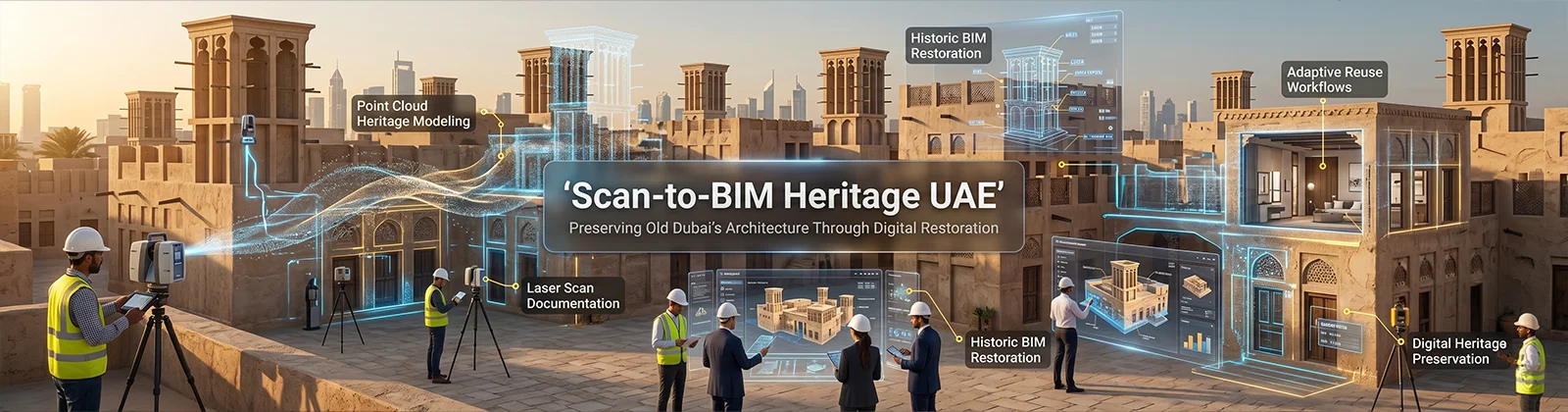
Using laser scanning and point cloud modeling, Scan-to-BIM heritage UAE allows for the accurate preservation of historical buildings through digital assets for heritage and renovation projects in the UAE. In Dubai, by utilizing scan-to-BIM technology, it can record, restore, and refurbish older buildings while preserving their original architectural features. It allows for accurate and efficient planning of conservation projects, adaptive reuse, and renovations.
Digital Preservation of Heritage in the UAE
The rapid growth of Dubai's urban landscape now presents a serious need for the preservation of any remaining pieces of the city's historic buildings. Traditional metadata and surveying techniques do not effectively record all of the complex features of heritage. This is where the Scan-to-BIM Heritage UAE Workflows become a game-changer.
By using laser scanning for the documentation of existing buildings and pairing these with a Building Information Model (BIM), engineers and heritage consultants are able to create accurate digital reproductions of the building in question. These models can be used to help to continue the architectural legacy of the building and allow it to be renovated and used.
Across the UAE, especially in the old districts of Dubai (Al-Fahidi), Scan-to-BIM is becoming critical to achieving sustainable heritage conservation.
What is Scan-to-BIM in Heritage Projects?
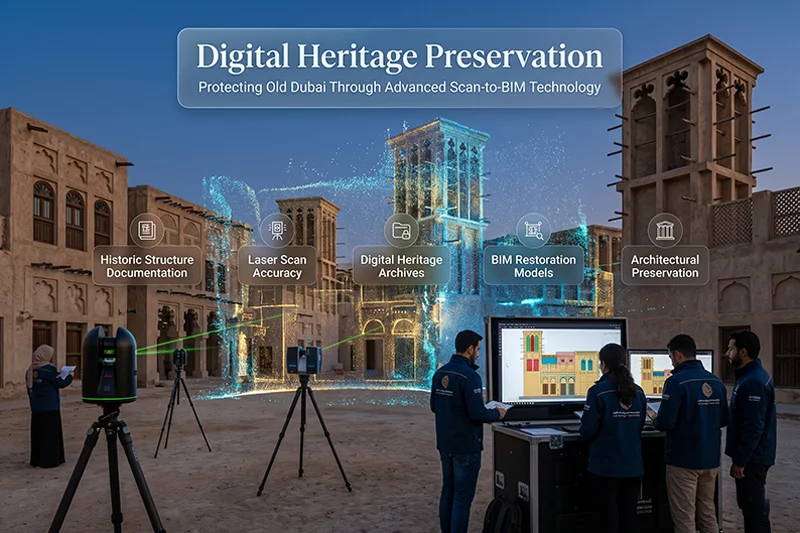
"Scan to BIM" is simply a name used for the methodology of capturing existing constructed observations through means of 3D laser scanning and converting the data into intelligent Building Information Models (BIMs).
When it comes to heritage contexts, it can involve:
- The detailed geometric capturing of the existing structures using laser scanners.
- Generating point cloud datasets to digitally depict the heritage buildings located in Dubai.
- Converting the heritage point clouds into Building Information Models (BIMs).
- Documenting the structural and architectural elements of the structures for restoration.
The above process ensures the complete digital preservation of the details, including small decorative elements, associated with historic structures.
Importance of Point Cloud Technology in Heritage Conversation
The Heritage conservation field is rapidly growing to embrace Point Cloud Services in UAE. A point cloud is a large collection of three-dimensional (3D) coordinates that are captured using laser scans and represent exactly the geometry of the façade of any building.
Examples of the many benefits of using point cloud technology include:
- Ensure that heritage structures are documented accurately.
- Help preserve and protect many fragile architectural elements.
- Reduce human errors made when measuring manually.
- Much quicker data acquisition than conventional surveying methods.
When conservation teams use a point cloud scan with a Building Information Modelling (BIM) workflow, they can create detailed digital models of historic mosques, fortresses, wind towers, and even traditional Emirati homes.
Scan-to-BIM for Renovation & Adaptive Reuse
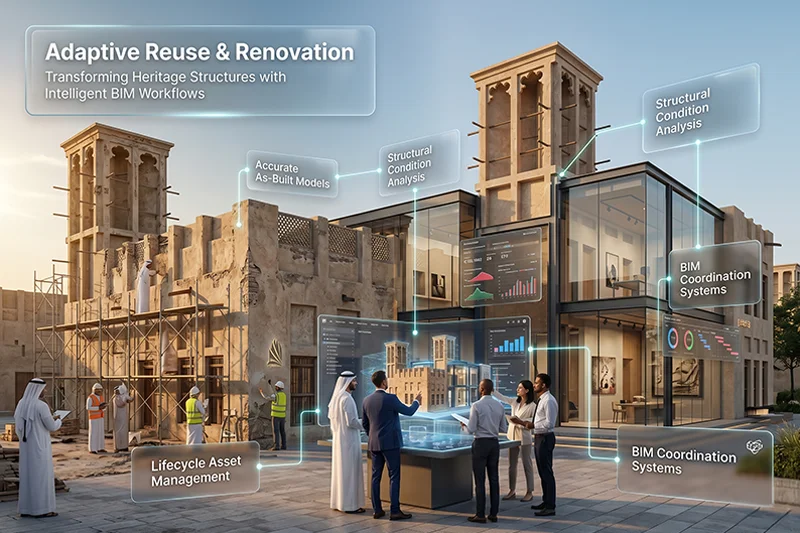
Along with its uses in preserving buildings, Scan-to-BIM is also commonly utilised for renovation to existing structures and adaptive reuse projects. One good example of how workflows for adaptive reuse can be implemented is the adaptive reuse case studies found within global BIM applications, such as Integrated Designers BIM for Adaptive Reuse.
Scan-to-BIM in the UAE is often used to assist with:
- Creating Accurate As-Built Documentation - Many historic buildings were constructed before modern architectural standards were developed, so there may not be an accurate set of original or updated drawings. Using scan to BIM workflows allows for reliable digital documentation to be generated from current field conditions.
- Early Detection of Structural Issues - Laser scans can be used to reveal deformation, cracking, misalignment, and damage when there would not be anything visibly wrong upon manual inspection.
- Detailed Restoration Planning - Creating detailed BIM models provides a way for teams to create a plan for restoring a building that maintains the integrity of the original architectural elements.
- Multidisciplinary Team Coordination - Architects, engineers, contractors, and conservationists all working off of one central BIM model that can be collaboratively developed.
- Ongoing Facility Management Support - After restoration is complete, BIM models continue to support future maintenance, renovations, and conservation efforts throughout the life of the building.
For architects and consultants who work on projects located on a heritage site, Scan-to-BIM is an indispensable tool in their toolkit.
Growing Demand for Scan-to-BIM Services in the UAE
The increasing demand for Scan-to-BIM services in UAE is primarily driven by government conservation programs and restoration projects related to tourism.
Leading providers have adapted their offerings to support and facilitate this transformation of the built environment by providing advanced BIM modelling, specifically for heritage structures.
Some common services provided are:
- 3D laser scanning and capturing
- Point cloud registration and processing
- LOD (Level Of Detail) BIM Modelling
- As-Built documentation of heritage structures
- Outsourcing laser scan-to-BIM services for international clients.
A large number of architectural firms are now choosing to outsource their laser scan-to-BIM services to specialised providers to ensure that they get high-quality results at a cost-effective price.
Preserving Old Dubai Through Digital Heritage Modelling
As modern urbanisation continues to expand throughout Dubai, neighbourhoods such as Al Seef and Al Fahidi Historical Neighbourhood are now showcasing ways in which heritage conservation can co-exist with urban development.
By utilising Scan-to-BIM heritage UAE methodologies, professionals involved in restoration projects can create a digital archive of historical structures before any work is done. This provides long-term protection of built heritage through maintaining a permanent historical record of (and ensuring) the built heritage for future generations.
Working with digital BIM environments, all parties in the construction process can visualise renovation results prior to construction commencing. This helps to diminish uncertainty associated with project costs and schedule, and ultimately provides a basis for making informed decisions.
Why UAE Developers Are Investing in Scan-to-BIM Services
The construction industry in the UAE is beginning to incorporate building information modelling (BIM) standards in both new construction and renovations of existing structures. Authorities involved with preserving heritage, developers of real estate development, and firms involved with architecture have all begun to see how valuable it is to produce accurate digital outputs from the design process, as processes have been streamlined through the BIM process.
Scan-to-BIM Services are growing in demand for the following reasons:
- Increased project delivery speed
- Reduced rework
- Increased coordination of design
- Precision in estimating quantities
- Precision in completing renovations
- Long-term management of assets
If the restoration projects are at a more complex level, the majority of companies utilise an experienced third-party BIM vendor for producing scan-to-BIM services, as there are currently very few companies that have extensive experience in this area, due to the nature of work typically associated with heritage modelling.
Point Cloud to BIM Model Workflow
The workflow for Point Cloud-to-BIM Service Providers in the UAE typically follows the steps below:
- Data Acquisition - Data acquisition using laser scanners to collect millions of 3D spatial points from historical buildings.
- Point Cloud Processing - Processing point cloud data by cleaning it, aligning, and registering it as one complete 3D model.
- BIM Conversion - Converting point clouds into intelligent BIM objects (walls, columns, and arches) by architects.
- Model Validation - Validating the BIM model to ensure measurement accuracy against real-life measurements.
- Restoration Planning - Using the BIM model for contract documents, structural analysis, and renovation design by engineers.
This workflow provides high-quality digital preservation of heritage buildings.
Role of Designheed UAE in Scan-to-BIM Solutions
Designheed UAE supports AEC practitioners in utilising modernised workflows for restoration and renovation with high-tech digital project delivery services as well as advanced BIM solutions.
With an extensive amount of experience in modelling, implementing, coordinating, and capturing reality-based data into BIM models, Designheed works closely with Architecture & Construction firms in the UAE with restoration/renovation projects, including:
- Data Processing from laser scanning (LIDAR)
- Point Cloud Modelling
- Creating as-built BIM Models
- Clash Detection
- Provide LOD 300 - 400 BIM Models
- Create Coordination Workflows for Renovation Projects
By incorporating Point cloud to BIM services (BIM) into restoration projects, Designheed has provided tools to preserve architectural heritage as well as streamlining the process for renovating existing buildings.
Conclusion
To keep the architectural identity of the Old Dubai in its original form requires not only a traditional form of restoration. By utilising advanced Scan to BIM Heritage workflows in the UAE, point cloud heritage buildings in Dubai can now be digitally documented, restored, and maintained to an incredibly high level of fidelity.
With the UAE continuing on the path of modernisation while at the same time preserving its culture, technologies such as Point Cloud Scan to BIM and BIM outsourcing in UAE will assist in protecting the architectural heritage of the region for generations to come.
Read More - MEP BIM Coordination in UAE
Questions People Frequently Ask
Q1: Why is Scan-to-BIM important when it comes to heritage buildings?
Ans: The architectural features of historically significant buildings do not have accurate documentation. Therefore, through the Scan-to-BIM, architects can preserve the accurate digital records of the buildings for restoration purposes and conservation projects.
Q2: What are Point Cloud Services?
Ans: Point Cloud services allow physical building data to be captured using laser scanning technology to create accurate 3D point cloud information.
Q3: Is there accuracy in Point Cloud Scan to BIM?
Ans: Using the latest Laser Scanner technology can produce millimeter accuracy, which makes it the best available technology for heritage and complex renovation projects.
Q4: Does Scan-to-BIM help in renovation projects?
Ans: Yes, scan-to-BIM services in the UAE can assist in planning and coordination with all disciplines of the renovation project, as well as reducing construction mistakes during the construction process.
Q5: Why should companies outsource their laser scan-to-BIM services?
Ans: Many companies choose to have their laser scan-to-BIM services performed by a BIM-specific company for faster schedule completion, technology expertise, and lower overall project costs.