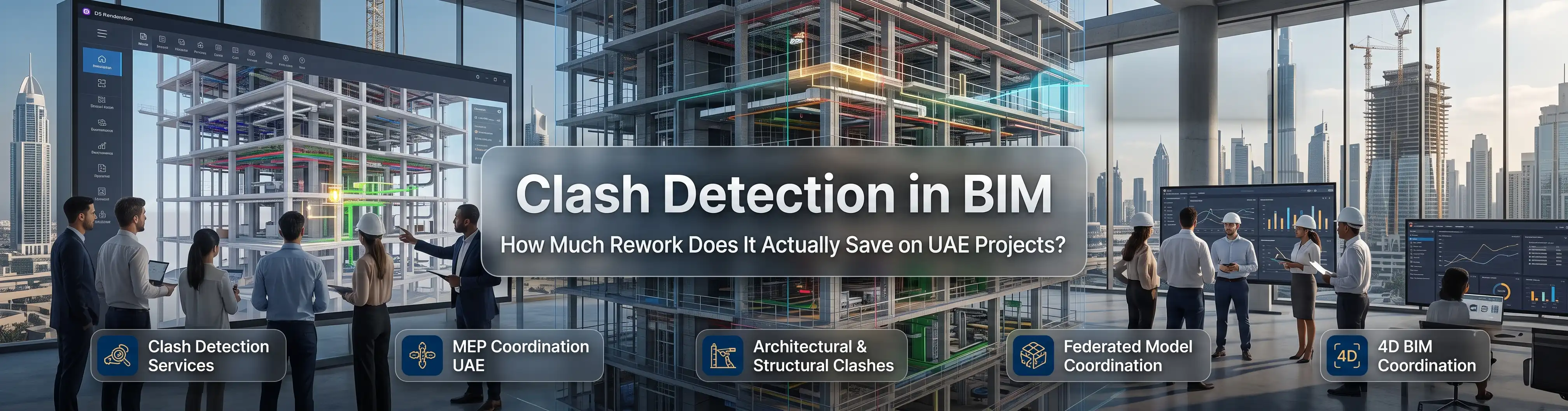
In the fast-growing construction in the UAE, even a minor coordination mistake may result in major delays, excess material usage, and additional activities at the site. Because of that, today’s Clash Detection Services are considered one of the most important components of modern Building Information Modeling (BIM) approaches. Being able to determine problems with design and coordination in advance enables the team to cut down potential obstacles during construction.
When working on various projects within Dubai, Abu Dhabi, Sharjah, and UAE in general, Designheed UAE applies to BIM-based coordination methods to figure out possible clashes among architectural, structural, and MEP systems. The outcome here is a better coordination process, reduced number of unexpected issues, and greater certainty when it comes to construction results.
What is Clash Detection in BIM?
Clash detection in Building Information Modeling (BIM) refers to how conflicting parts of a building are detected through the use of 3D models and architecture before construction work begins. Clash detection in BIM means checking if architectural, structural, mechanical, electrical, and plumbing data are coordinated appropriately.
An expert in BIM coordination can combine such models into one system to ensure the availability of the information about the places of clashes and conflicts. At Designheed UAE, a multi-disciplinary BIM team synchronizes potential problems to solve them before the start of the actual construction work.
How Much Rework Can Clash Detection Save on UAE Projects?
The exact level of BIM rework reduction is dependent on project size, quality of the model, standards of coordination, and how soon clashes are solved. The rule is simple, however: solving problems in design is a lot easier than fixing them after installation.
-
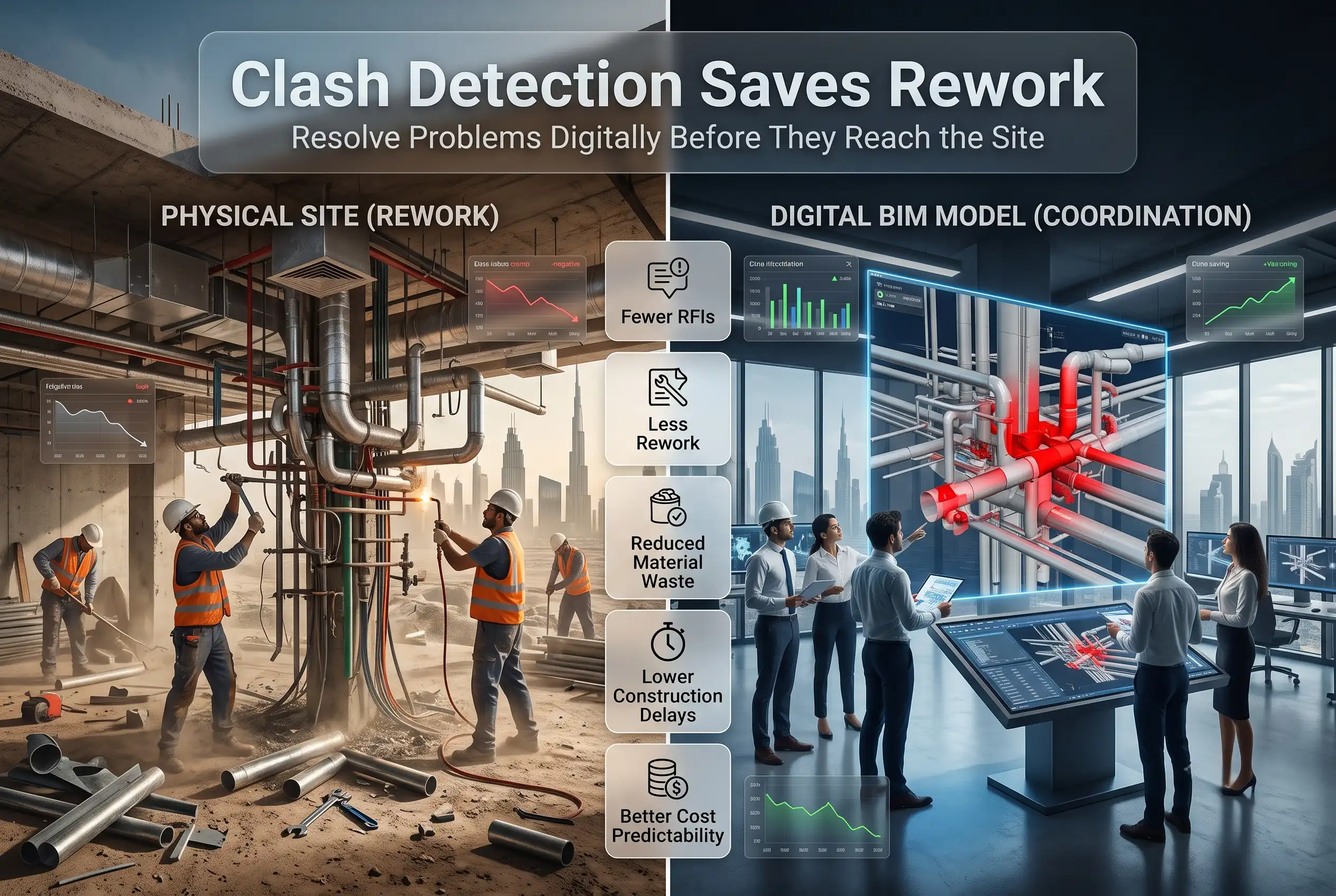
Cost Of Undetected Clashes - Unnoticed clashes seldom remain insignificant. Just a single unnoticed clash between the structural beam and the HVAC duct would bring about a delay on a whole floor and would require contractors to remove already completed work, reorder materials and renegotiate schedules. On the UAE sites, where different trades execute all the works at the same time, a single unnoticed clash may affect many processes ahead and increase both timeframes and costs of the project.
-
How Early Clash Detection Minimizes Rework - Early clash detection helps to transfer solving issues from the construction site to the design process. If a clash is recognized during a coordination meeting rather than at the time of installation, it may be solved in a digital way, saving a lot of money. This is one of the most evident examples of how BIM helps to minimize rework for project teams nowadays as it is always cheaper to correct the model rather than repair the building.
-
From Design Errors to Construction Savings - Every clash that is resolved on the screen is avoided on the site. Fewer change requests, smaller number of materials returns, and more timely project completion result in savings directly. For contractors in UAE, who are working on tight deadlines, this predictability can be perceived as important as the dollars saved thanks to collision detection.
Common Types of Clashes Found in BIM Projects
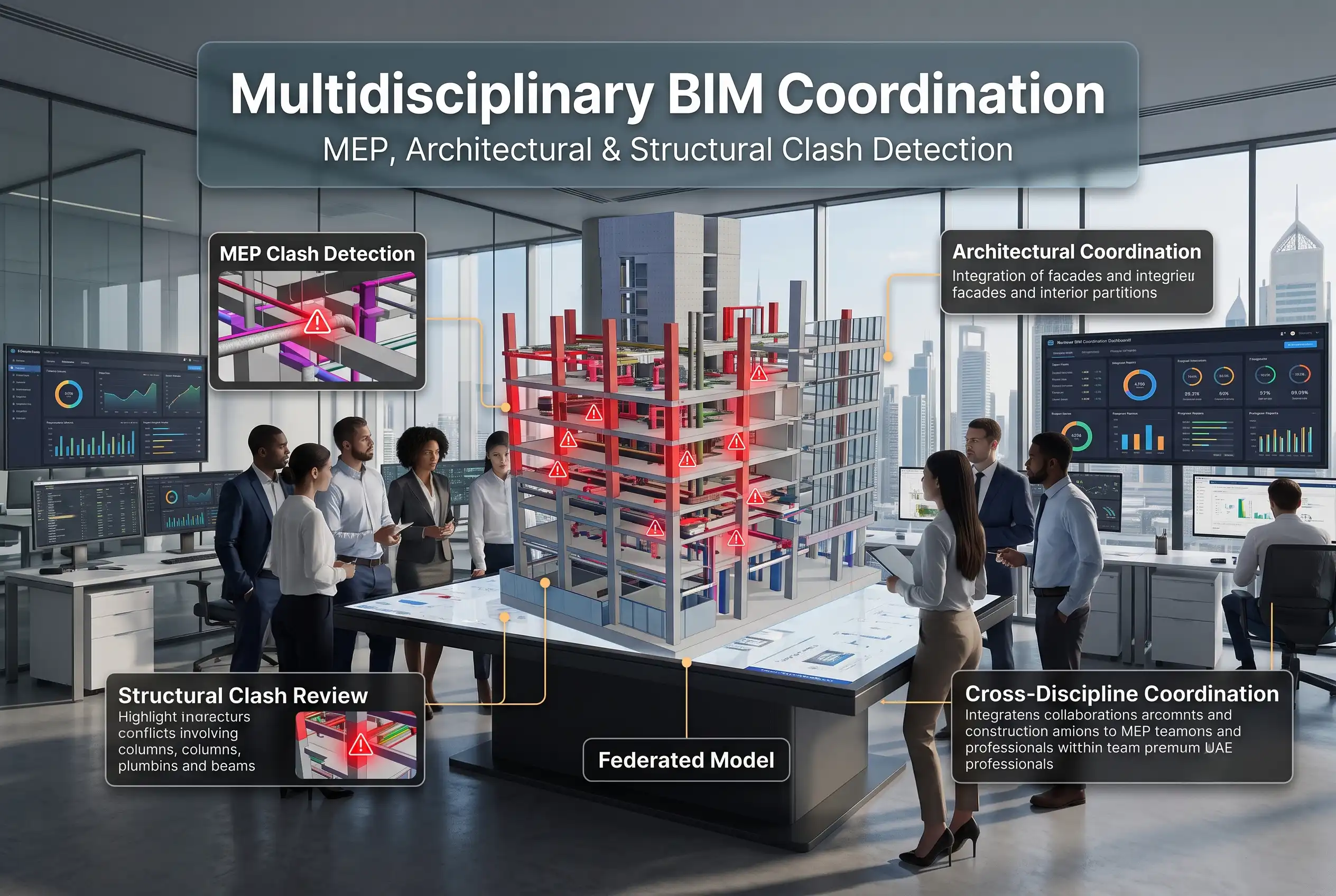
BIM clash detection usually reveals three major categories of conflict during construction clash detection reviews:
Hard Clashes
-
Occur when two physical objects occupy the same space, such as a pipe hitting a structure column.
-
They are the most evident conflicts, as they make construction impossible until they are resolved.
-
Hard clashes are usually treated as number one priority in any clash detection review.
Soft Clashes
-
Happens in case there is not enough clearance around an object, for example, if the duct is too close to the wall, making access and maintenance impossible.
-
Soft clashes do not stop construction immediately, but they will bring serious operational and safety problems.
-
Soft clashes need to be detected in case of mechanical and electrical rooms.
Workflow and Sequence Clashes
-
Happens when construction sequence planned conflicts with the model, such as in case one trade needs access to the area before another one finishes.
-
Workflow and sequence clashes influence the scheduling rather than the physical space.
-
Detection of these clashes will help save time on 4D BIM project as well.
Why Clash Detection Services Are Important for UAE Construction Projects
Due to complex building projects in UAE, effective coordination through digital means becomes crucial. Big projects often require the work of not only architects but also structural engineers, MEP engineers, contractors, specialist subcontractors, and many suppliers.
-
Supporting Complex Building Projects - Clash Detection Services provides support with the complexity of building projects where many systems have to function in a small area. In order to detect problems with architecture, structure, and MEP beforehand, Designheed UAE utilizes model-based coordination.
-
Improving Coordination Across Multiple Disciplines - Architects, structural engineers, and MEP consultants or BIM coordination UAE operates within the single digital space where project teams can examine the connections between different disciplines. Multi-disciplinary BIM coordination allows these parties to come together in a unified, federated model, thereby ensuring everybody is aware of possible clashes.
-
Supporting Faster and More Accurate Construction - Once clashes are resolved prior to construction, team members can operate off of the same coordinated model. As a result, on-site delays are kept to a minimum and more accurate, reliable outcomes and deliveries, which UAE stakeholders now expect to have become the norm for their BIM coordination partners, can be achieved
Read More - BIM for MEP Coordination in Dubai High-Rises
Why Choose Designheed UAE for Clash Detection Services
Designheed UAE is a service provider that specializes in the professional provision of clash detection services with the aim of facilitating the seamless flow of BIM operations and workflows throughout the project duration.
-
Accurate Model-Based Clash Identification - Designheed examines BIM models to determine the existence of potential problems in various disciplines including architectural, structural, and MEP disciplines. In this respect, clash detection in architecture, clash detection in structures, and clash detection in MEP will be carried out.
-
Detailed Clash Reports - All recognized clashes can be classified into the reports by the designed location, point of view of information, discipline, and description. This allows the members of the project team to be aware of the incident.
-
Faster Issue Resolution - Identifying conflicts at an early stage allows project teams to have ample opportunity to explore alternatives and implement coordinated design adjustments. This minimizes unnecessary back-and-forth communication and prevents problems from reaching the construction site.
-
Improved Project Coordination - By providing professional BIM Coordination services, Designheed UAE builds a structured coordination workflow. The use of federated models and frequent clash reviews makes it easier for stakeholders to visualize the project and keep all disciplines organized.
Conclusion
In the case of construction projects in UAE, BIM clash detection serves as a useful means of minimizing rework and enhancing coordination amongst project teams. No longer do project teams need to find out about clashes after materials have already been installed; they can now virtually identify and remedy clashes before starting construction.
The efficacy of clash detection services lies in the fact that solutions are provided early on. Designheed UAE facilitates project teams in minimizing unnecessary construction issues and achieving smoother workflow through accurate models, comprehensive reports, coordination across different disciplines, and efficient audits.
Frequently Asked Questions
Q1. How does BIM clash detection reduce rework? −
The process of BIM clash detection helps identify any clashes or issues before the construction starts. Therefore, construction teams can update the 3D model, provide solutions where necessary, and avoid any potential problems that may require demolishing or fixing broken structures.
Q2. What types of clashes can BIM identify? +
BIM can help identify clashes, for example, hard clashes, soft clashes, and workflow or sequencing clashes. Further, it is capable of defining contradictions between architectural, mechanical, plumbing, and electrical systems.
Q3. When should clash detection be performed? +
Clash detection is necessary at the design and coordination phases and other crucial points throughout the duration of the project. It's useful to conduct clash detection several times throughout the project in order to determine any troubles appearing due to possible changes in design.
Q4. How does MEP clash detection help construction projects? +
As far as MEP clash detection is concerned, it allows identifying conflicts between mechanical, electrical, plumbing, and other building services that are present within several production stages.