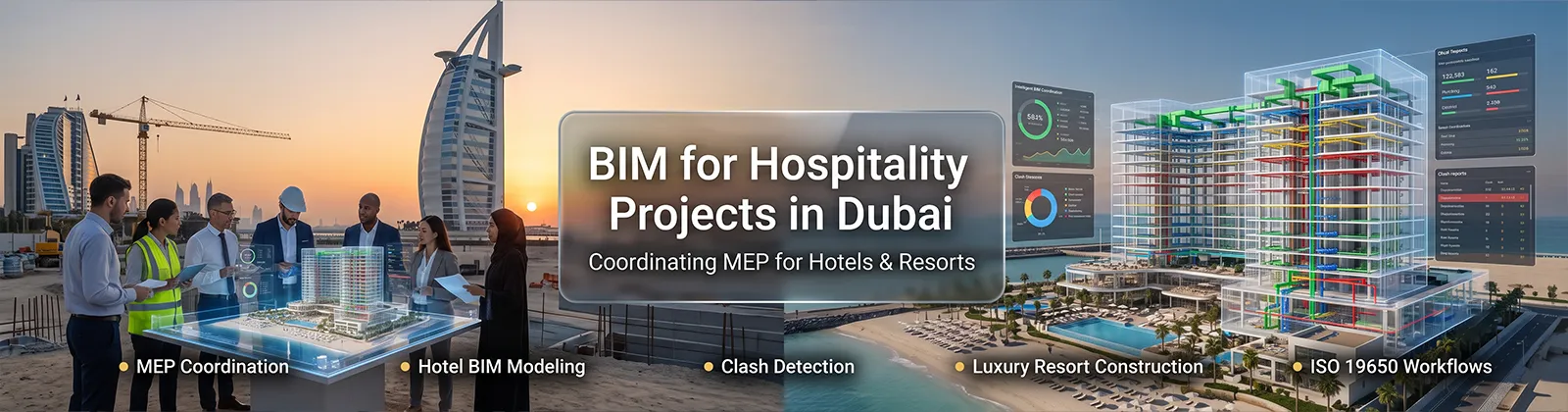
Dubai’s hotel industry keeps growing rapidly, with the emergence of new upscale accommodation facilities and integrated sites changing the silhouette of the city. Every hotel building, such as hotel lobbies and swimming pools, is constructed on a full set of architectural, structural, and engineering systems that must function smoothly.
Coordination of cooperation between these types and systems is vital for the success of every hotel construction project as even the presence of one duct can result in delays. This is why BIM applications in hospitality have become so necessary in Dubai; it simplifies interactions and reduces mistakes, enabling efficient project implementation. The application of BIM is at the core of Designheed UAE, which allows excellent coordination to work on hospitality projects.
What Is BIM in Hospitality Construction?
Hospitality buildings are not just huge housing structures. They consist of plenty of rooms for guests and various services like MEP running through the thin ceiling, high level interior design allows little possibility for changes and also includes lots of amenity areas for general public.
Restaurants, commercial food places, swimming pools, spas, special systems against fires and lots of other characteristics make it clear why this kind of building is one of the most complicated.
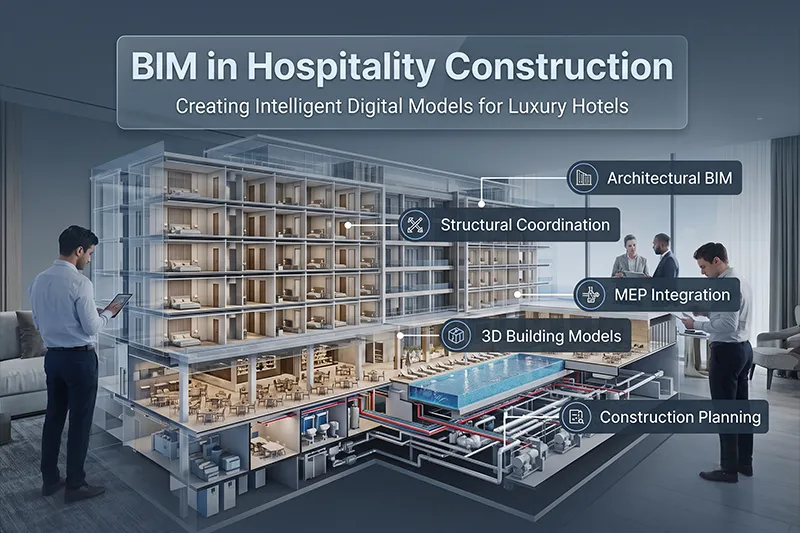
What is BIM in Hospitality?
Building Information Modeling (BIM) is a process of digital creation of intelligent models which provides users with data. When it comes to hospitality construction, BIM models architecture, structure and MEP disciplines and gives the opportunity to the team to see the result before construction starts.
Importance of MEP Coordination in Hotels and Resorts
The significance of MEP coordination cannot be overstated in the hospitality construction sector.
-
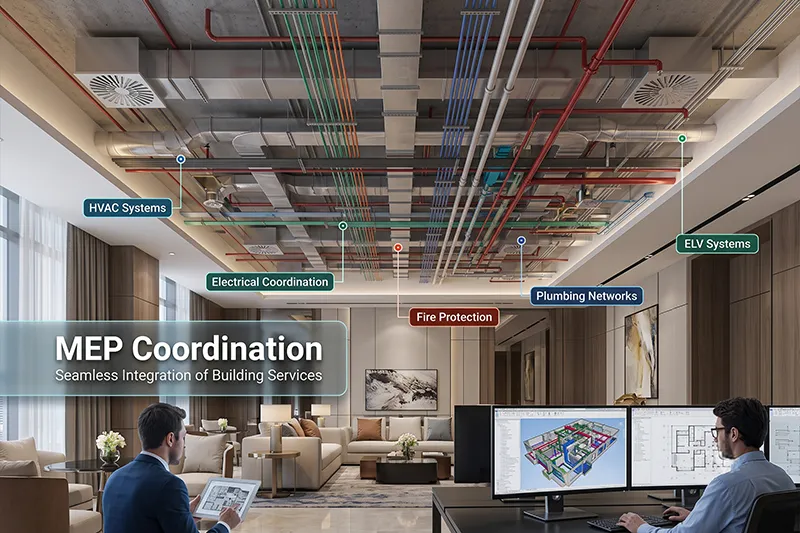
Coordination of HVAC - The arrangement of ductwork and air handling systems is responsible for ensuring comfort for hotel guests while keeping in mind any potential clashes with structures and architectural features.
-
Coordination of Electricity System - The electrical systems must efficiently meet the requirements of lighting, power, emergency systems, and hotel operations without disrupting the ceiling structure or interior design.
-
Coordination of Plumbing and Drain System - The plumbing, sanitation, and drainage systems require accurate coordination of all components for the effective operation in guest rooms, kitchens, spas, and swimming pools.
-
Coordination of Fire Safety Systems - The fire-detecting equipment, fire-alarm, and smoke removal systems should be compliant with the requirements established by Dubai regulations and should not cause difficulty for the services of other electric systems installed in the building.
-
Coordination of Low-Voltage and ELV Systems - In hotels, there are a number of various ELV systems like CCTV, access control, Wi-Fi, IPTV, or building management system solutions which require solving cable routing.
-
Coordination of Kitchen and Laundry Services - Commercial kitchens and laundry facilities require special ventilation, drainage, gas, and electrical services which require dedicated coordination.
Common MEP Coordination Challenges in Dubai Hospitality Projects
The companies involved in building hotels and resorts regularly face the problem of congested ceilings, few service shafts, and the conflicting routing system of MEP and architecture. In addition to that pressure put on the companies, they also must deal with numerous changes to original project designs.
How BIM Solves Coordination Problems
BIM for Hospitality Projects Dubai permits project teams to manufacture all-encompassing 3D models encompassing the architectural, structural, and MEP disciplines. The use of model federation and conflict check helps detect any hindrances before construction starts.
BIM promotes design verification, constructability reviews, quantity takeoff, shop drawings creation, and collaboration meetings. In turn, Designheed UAE employs advanced BIM workflows to decrease exposure to risks, boost precision of installation, and increase effectiveness of building.
Clash detection in hotels Projects
Clash detection is one of the important functions of BIM. It detects hard clashes, where two physical aspects intersect with one another; soft clashes, where there are violations of clearance requirements; and workflow clashes causing conflicts in construction processes.
There are cases of HVAC ducts that intersect with structural beams, pipe conflicts with power cables, fire sprinklers interfering with lights, kitchen exhaust systems clashing with ceiling systems, and the installations of MEP systems in guest rooms competing for space. Resolving such issues virtually helps reduce the time and costs of construction.
BIM workflow in hotel projects
A proper workflow of BIM leads to good coordination of work at all project stages. It all starts with making architectural and structural BIM models, and at this stage MEP is created. After the models are created, they are merged for clash detection.
After designing reviews and constructability assessment, the construction documents and shop drawings are produced. Then during construction, BIM helps with sitting coordination and progress tracking and provides support in making an accurate as-built BIM model for facility management.
Benefits of BIM for Hotel Developers and Contractors
BIM in Hospitality Projects Dubai brings many benefits, such as quicker fulfilment of projects, lesser chances of reworking, better coordination of design, better construction sequencing, reduction of costs in carrying out the project, and greater precision of installation.
BIM also strengthens communications among participants of the project, facilitates the quality of the process, cuts the delays, and makes management easier after the building is handed over.
BIM Standards Used for Hospitality Projects in Dubai
Successful BIM implementation includes the use of internationally accepted standards, including ISO 19650, Dubai Municipality BIM Guidelines, Level of Development (LOD) standards, and COBie used for the management of asset information.
To realise all the benefits of the implemented BIM across the project, several industry-leading platforms such as Autodesk Revit and Navisworks allow for coordinated modelling and clash detection.
Why Developers Outsource Hospitality BIM Services
Several developers prefer to use outsourcing as a way to acquire qualified specialists, innovative technologies, and a team that can help develop large projects without raising additional time and costs within the company.
Outsourcing allows accelerating project implementation, saving costs, ensuring communication and interaction of various areas of knowledge, receiving post-project support, and getting reliable quality assurance. Designheed UAE is a provider of varied kinds of BIM services designed for hospitality projects.
Why Choose Designheed UAE for Hospitality BIM Services
Designheed UAE is a well-known BIM contractor for hotels, resorts, serviced apartments, and other projects. Our services include Architectural BIM Modeling, Structural BIM, BIM Services for MEPs, Clash Detection, BIM Coordination, Construction Documentation, Shop Drawings, Scan-to-BIM, LOD 300-400 modeling, etc.
Combining technical expertise and effective BIM methodologies, Designheed UAE allows customers to get high-quality hospitality projects.
Conclusion
BIM for Hospitality Projects Dubai is growing in importance as hospitality projects in Dubai become more complicated. BIM technology makes it possible to model accurately, detect clashes, and manage cooperation processes. This helps to avoid risks and lower costs in construction.
Designheed UAE offers comprehensive BIM coordination and MEP modelling services for luxury hotels, resorts, and serviced apartments in Dubai. Contact Designheed UAE and make sure that the process of building a hospitality facility will be as comfortable, efficient, and smooth as possible.