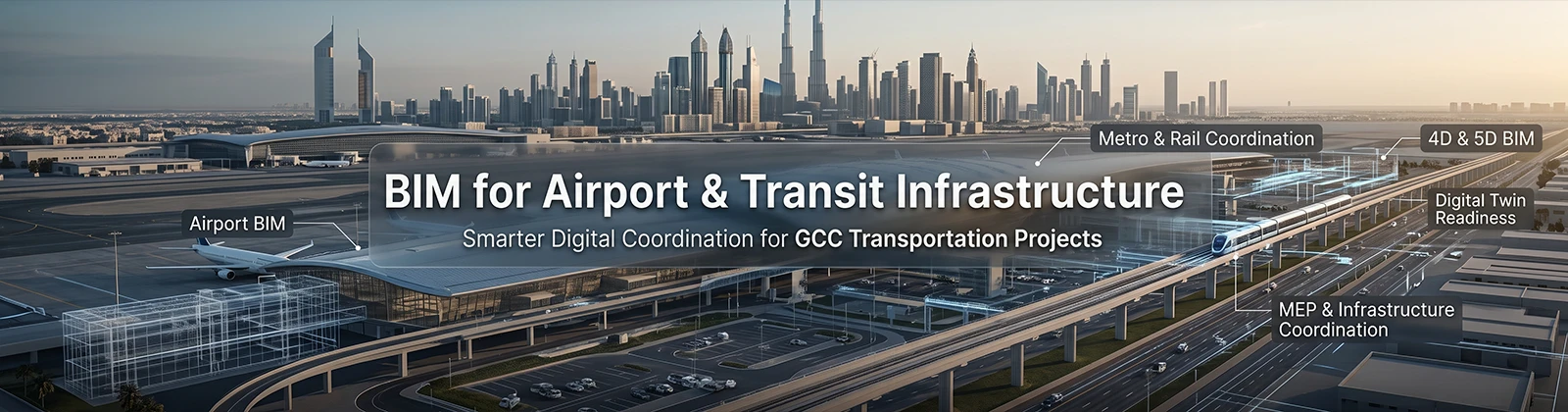
The GCC is experiencing one of the most ambitious projects of infrastructure expansion worldwide. The BIM for Airport & Transit Infrastructure in GCC is revolutionizing the planning, designing, construction, and operations of transport infrastructure in the region. With BIM, there is improved collaboration across multiple disciplines, clash reduction and prevention, cost and schedule management, and digital twin generation. As the airport and transit infrastructure in GCC continues to grow, BIM will help deliver smarter, sustainable, and resilient infrastructure.
What Is BIM in Airport and Transportation Infrastructure?
BIM for airport and transportation infrastructures in GCC utilizes smart 3D modeling and digital data to plan, design, construct, and manage airports, railroads, metro systems, roads, tunnels, and transit systems. This allows project teams to work effectively and efficiently while enhancing accuracy, coordination, and decision-making.
Some key advantages include:
- 3D Visualization: Offers an insight into complex designs for infrastructure.
- Clash Detection: Detects conflicts in architectural, structural, MEP, and civil systems.
- 4D & 5D BIM: Improves construction scheduling, quantity takeoffs, and cost control.
- Improved Coordination: Enhances coordination of multiple project disciplines.
- Asset Management: Facilitates efficient operation and maintenance of post-project completion.
In GCC projects, Designheed UAE offers BIM Modeling, Coordination, Infrastructure Design, and Digital Engineering services.
Why Airport and Transit Infrastructure Projects Are So Complex
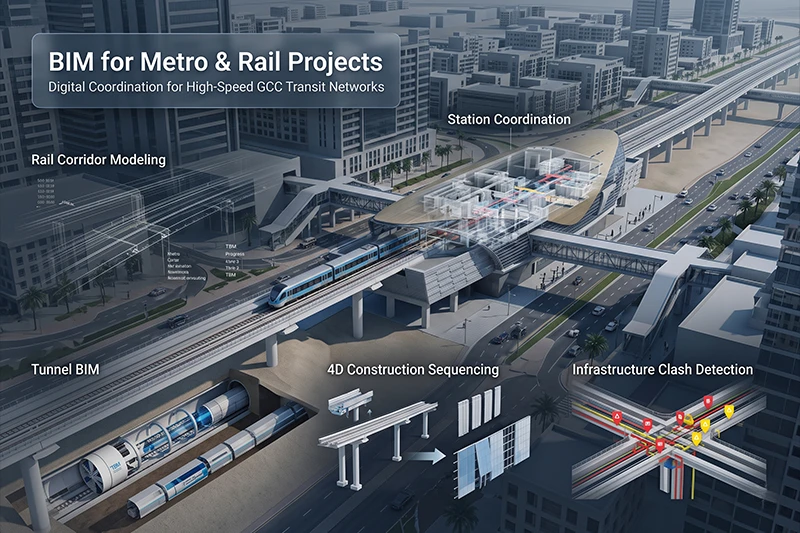
Transportation projects are a unique type of project in their own right. Not only do they possess extremely large-scale projects, numerous stakeholders and consultants, and complicated MEP systems that should function without any glitches, but they are also subject to safety and regulatory regulations. Moreover, many projects require the construction of a facility in operation, thus involving busy passenger movement and active construction sites. It is clear that there is more required for such projects other than simple spreadsheet calculations and 2D drawings.
The complexity involved in the design and delivery of an airport or transit facility is tremendous, and needs perfect coordination at all levels, involving people, processes, systems, and infrastructure. Here are some of the reasons why airport and transit projects are very complex:
- Enormous Size: Complex networks of terminals, stations, runways, tracks, roads, and utilities.
- Various Stakeholders: Diverse teams of architects, engineers, contractors, consultants, authorities collaborate throughout the project lifecycle.
- Integrated Systems: MEP, structure, civil, rail, security, and technology systems.
- Stringent Regulations: Projects must meet the rigorous safety, security, and operation standards.
- Live Operations: Operations must proceed without disruption during construction periods.
- Existing Infrastructure: Accurate integration of new facilities with existing infrastructure and utility systems.
- Time-bound Nature: Aggressive timelines leave little room for design conflicts, project rework and delays.
- BIM Coordination: Perfect coordination digital models reduce errors, improve visibility, clash detection and risks.
Read More - How to the Cost Control of 4D and 5D BIM for UAE
Applications of BIM in GCC Transportation Projects
BIM is revolutionizing the planning, design, construction, and management of transport infrastructure in the GCC region. This technology is currently used to design and manage many Types of infrastructure including:
- International Airports: Facilitates planning of terminals, MEP integration, baggage systems, utilities, and passenger movement planning.
- Metro Railways: Coordinates stations, tunnels, rail lines, structures, and MEP systems.
- High Speed Railways: Helps in the coordination of railway corridors, bridges, tunnels, stations, and the related infrastructures.
- Bus Terminals & Transportation Stations: Facilitates spatial planning, access, multi-disciplinary coordination, and circulation.
- Airport Expansion Projects: Makes it possible for existing and additional infrastructures to be planned without disrupting current operations.
- Logistics & Cargo Centers: Helps plan efficiently for warehousing facilities, cargo centers, transportation routes, and utility systems.
While each type of infrastructure poses its own challenges regarding design and coordination, BIM offers a unified digital solution to foster collaboration, minimize clashes, control costs, and deliver an efficient infrastructure project. Designheed UAE can help GCC transport infrastructure projects use BIM for their infrastructure planning and management needs.
Key BIM Services for Airport and Transit Projects in UAE
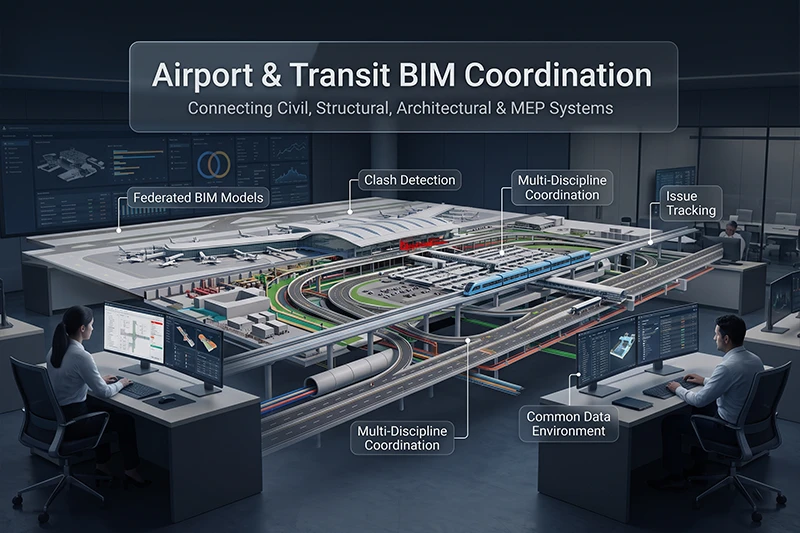
A complete BIM workflow will allow you to plan, design, coordinate, construct, and operate an airport and transit project effectively. Some of the BIM solutions include:
-
Architectural BIM Modeling: It helps in developing the digital model of airport terminals, transit stations, passenger spaces, and facilities.
-
Structural BIM Modeling: It helps in the design and coordination of structures, bridges, tunnels, and other structural components.
-
Civil BIM Modeling: It helps coordinate roads, railroads, drainage, and other civil infrastructures.
-
MEP BIM Services: It helps coordinate mechanical, electrical, and plumbing infrastructure.
-
Scan-to-BIM: It allows for converting scans and existing site conditions into digital models.
-
Clash Detection: It helps in identifying any clashes between different disciplines before construction.
-
Construction Documentation & Shop Drawings: It provides drawings for effective site implementation.
-
As-Built BIM Models: It provides models of the finished product for facility management.
Designheed UAE offers you all the above BIM solutions to facilitate effective coordination and construction of airports and transit projects in GCC.
Benefits of BIM for GCC Airport & Transit Projects
There are several key advantages for applying BIM in complex airport and transit construction projects in the GCC region. With the ability to coordinate all relevant design, construction, and asset information in one integrated digital environment, it will be possible to increase efficiency and reduce the number of errors that result in additional costs. Some of the key benefits include:
- Improved Design Coordination: The integration of architectural, structural, civil, and MEP disciplines.
- Reducing Rework: Design coordination that eliminates clashes prior to construction.
- Rapid Approval: Provides clear and coordinated information for all stakeholders involved.
- Improving Collaboration: Architects, engineers, contractors, and owners have access to the same data.
- Improved Quantity Take-Offs: Helps in material planning and estimating.
- Cost Savings: Decreases waste, rework, delays, and unnecessary construction modifications.
- Smart Construction Scheduling: 4D BIM facilitates visualization of the schedule and activities.
- Safety Planning: Identifies potential risks of the site and construction process.
- Lifecycle Asset Management: Provides valuable digital information for facility management.
With Designheed UAE, GCC airport and transit projects can leverage BIM to achieve better coordination, efficiency, quality, and long-term infrastructure performance.
Why Choose Designheed UAE for Airport and Infrastructure BIM
Designheed UAE offers unique BIM services for airports and transportation infrastructure projects in GCC. Services offered by Designheed UAE include airport BIM, civil and structural BIM, MEP coordination, Scan to BIM, clash detection, shop drawings, and construction documentation. Utilizing 4D and 5D BIM tools, Designheed UAE can deliver models which are highly accurate, well-coordinated, and fit to be used as digital twins. Designheed UAE works with various types of infrastructure projects including airports, metros, rail, logistics, etc., from the design phase to successful project delivery.
Key advantages of choosing Designheed UAE for BIM
-
End-to-End BIM Support: We deliver BIM Support from conceptual to construction and delivery of the project.
-
High-Accuracy Modeling: Delivering high-accuracy modeling due to the complexity of infrastructure projects.
-
Better Coordination: Our BIM support helps lessen the project clashes between various engineering disciplines.
-
Cost & Time Efficiency: Optimized planning through 4D/5D BIM integration.
-
Digital Twin Modeling : Models built for long-term use for asset management and project operations.
Conclusion
BIM is now the cornerstone of all airport and transport infrastructure projects delivered in the GCC. BIM process coordination, Clash detection, 4D and 5D planning, and Digital Twin preparedness come hand in hand to mitigate risks, streamline collaboration, and guarantee operational efficiency. For any developer, consultant or contractor hoping to deliver their next airport and transport project with complete peace of mind, Designheed UAE is the ideal partner for comprehensive BIM services tailored to the needs of GCC infrastructure.
Frequently Asked Questions
Q: What is BIM for airport and transit infrastructure? +
A: BIM employs digital modeling to enhance the planning, design, construction, and management of airports and transit infrastructure.
Q: Why is BIM good for GCC infrastructure projects? +
A: BIM saves money and time and enhances coordination and scheduling on infrastructure projects.
Q: Which BIM services are offered by Designheed UAE? +
A: Designheed UAE offers services in BIM modeling, MEP coordination, Scan to BIM, clash detection, 4D and 5D BIM, and construction documentation.
Q: Can BIM assist airport expansion projects? +
A: Yes, BIM assists in coordinating existing and proposed airport infrastructure and minimizes any construction-related challenges.
Q: Why is BIM important for GCC transportation projects? +
A: BIM allows for smart and coordinated development of transport infrastructure including airports and metros.