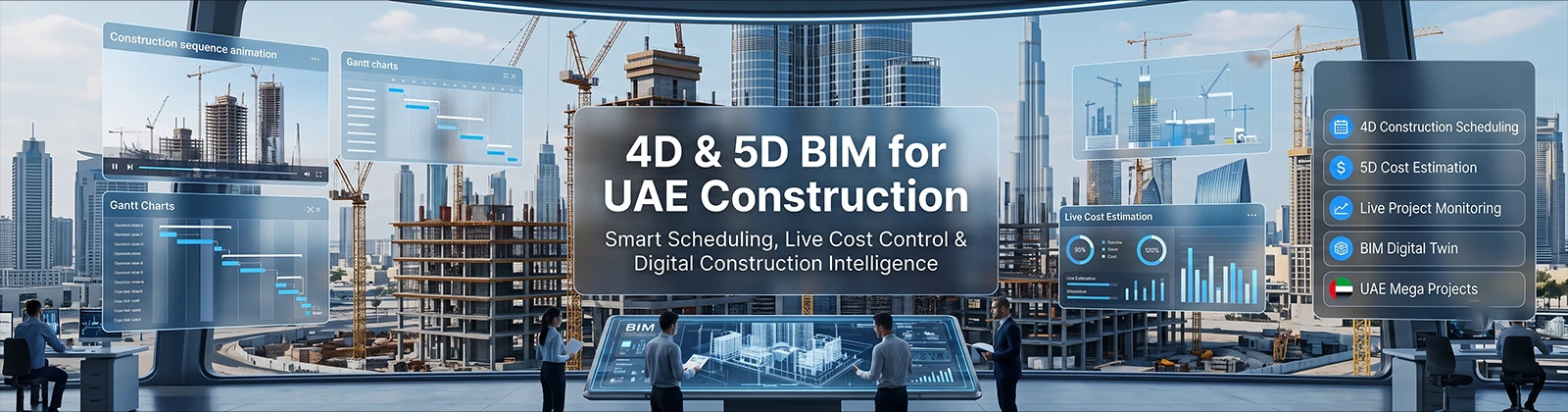
Dubai's skyline does not wait for spreadsheets. With mega-projects moving fast towards Vision 2033 milestones, and costs tightening as a result of fluctuations in the price of commodities and materials, developers in UAE cannot use a model that looks good only in the office.
Having a 3D file which outlines the visuals of the building isn't enough anymore. Now, teams have to know when each phase is going to happen and what it is likely to cost given the changing circumstances. This is what the 4D and 5D BIM technologies provide: a functional and interconnected system for scheduling and budgeting, rather than just an illustration of the building.
What is a 4D BIM?
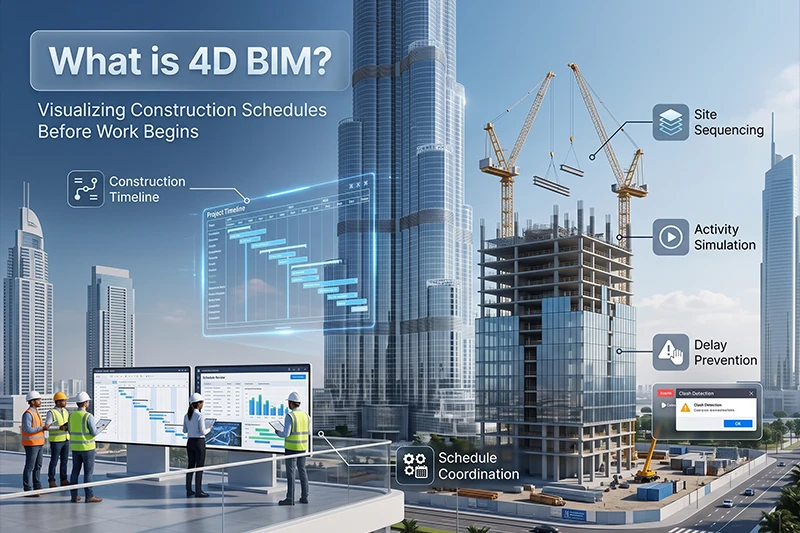
4D BIM construction is the way to add the element of time to their 3D model. Individual components of the model connect with the construction schedule, enabling the teams to visualize the entire build of the process without breaking the ground. In this way contractors can find problems in the building process and avoid them ahead of time. Designheed UAE creates these time-sequenced models so that contractors can see the overall timeline of any given project. They can identify conflicts with schedules, access issues, and other problems weeks before they might appear at the site. In short, simulation.
What is a 5D BIM?
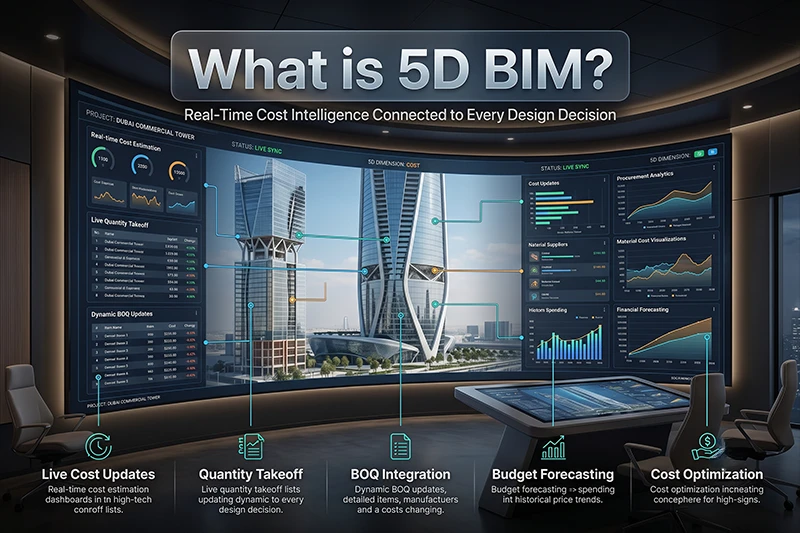
5D BIM is based on 4D technology and uses the same 3D geometry plus time and money formula to create the cost estimate. Costs and quantities are linked to the model, so any modifications in the design will give you a clear picture of expenses. The 5D BIM offers UAE developers to always control their budget not only monthly but at all times.
Reasons Why UAE Builders Need 4D and 5D BIM Together
While it may look like one involves both scheduling and costing of the UAE construction projects, one cannot solve those matters separately. Three factors prove that the idea of combining two elements is necessary:
-
Links Between the Vision and Deadlines: Goals related to Dubai 2033 plans and deadlines connected to a particular project should be considered.
-
Vital Role of BIM: A big number of tenders offered by the government and semi-government sectors require the use of BIM in the application process.
-
Volatile Supply Chain: Costs of materials change frequently, so budgets change each time, not just once per quarter.
It is important to keep in mind that quick scheduling based on outdated prices leads to undesirable costs and accurate prices on their own lead to the missed deadlines. Designheed UAE connects the two directions in one model which allows clients to see both sides at the same time.
The Role of BIM Outsourcing in Making 4D/5D BIM Affordable
Setting up a 4D/5D setup in-house is challenging as it involves acquiring licenses for Revit, Navisworks, and software for scheduling projects based on costs. The next step in this process will be hiring and retaining a team of modellers with the required skills. Therefore, outsourcing helps enter a new territory of possibilities, especially when a partner such as Designheed UAE provides:
-
Lower Software Costs: companies don’t have to spend money on licenses for every project.
-
Access to Qualified Professionals: the opportunity to hire a team of modellers only for the required period.
-
Scalability of Resources: the resources may be adjusted based on the requirements of projects.
-
Cost-effectiveness: having a partner in India helps lower costs of modelling services.
-
Constant Budget Control: hired professionals provide fixed-up data throughout the process of construction.
Thus, companies have to pay only for the modelling resources they use at this very moment instead of building a team of 5D specialists. Moreover, the method of delivery matters just as much as the result of the technical process.
What UAE Developers Should Ask a BIM Partner
UAE developers need to know a few things before signing the deal with their 4D/5D BIM partner. First, ask if their team is familiar with Revit and Navisworks, which are the software products that most UAE projects do work with. Next, it is important to see if the partner’s workflow complies with ISO 19650 information management standards. Third, developers need to clarify the LOD (Level of Development) applied at the stages of concept, design, and construction. Finally, it is important to ask how the systems work to have cost data continuously updated during the life cycle of a project.
Conclusion
The introduction of 4D and 5D BIM makes scheduling and cost monitoring one discipline instead of two different things. The UAE developer's connection makes sure that both the budget and the deadline are safe from time constraints and variable pricing. Designheed UAE allows developers to build this function without having to do so in-house.
Ready to Put Your Model to Work?
Talk to Designheed UAE about 4D and 5D BIM implementation for your next UAE construction project and turn your model into a live scheduling and cost control system.
Questions People Frequently Ask
Q: How does 4D BIM differ from 5D BIM?
A: 4D BIM incorporates construction scheduling into the 3D model while 5D BIM adds financial information on top so that budget is interlinked with the time and the geometry.
Q: Is the application of 5D BIM compulsory for construction projects in the UAE?
A: While its application is not compulsory, many tenders from both the government and the semi-governments require the use of BIM, while developers are provided with 5D during substantial projects.
Q: How much does 4D 5D BIM implementation cost?
A: Various factors affect the project costs including the project’s scale and software licensing but outsourcing to a specialized being partner like Designheed UAE usually lowers the BIM cost estimation implementation compared to recruiting specialists and building an in-house team.
Q: Does outsourcing 4D / 5D BIM help save money?
A: Yes, outsourcing developers have the advantage of consulting trained modelers and having access to the needed software suite without incurring the costs of hiring and licensing in-house.