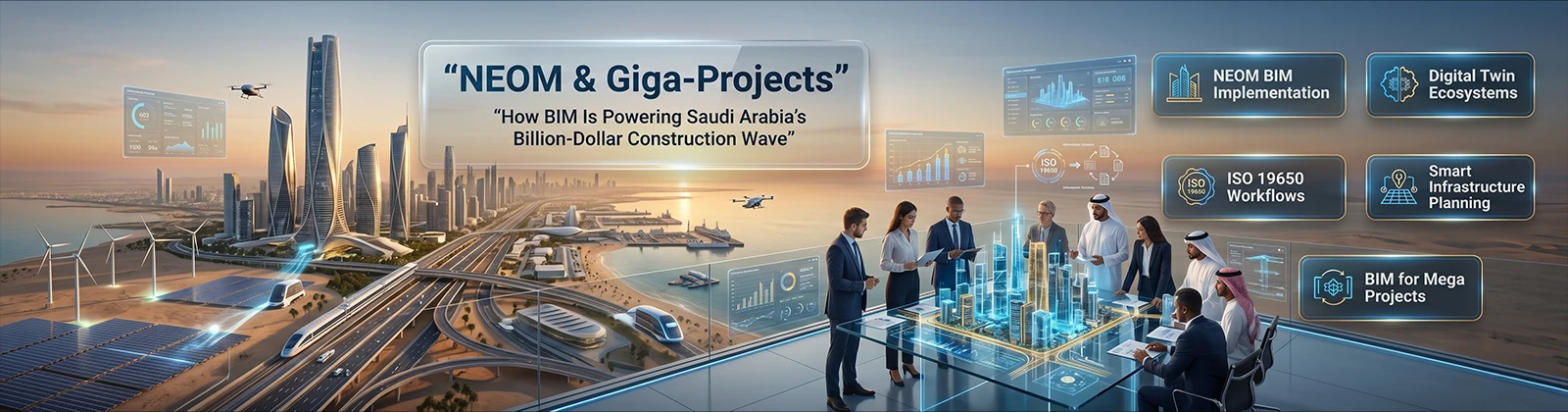
Saudi Arabia is rewriting the future of construction through massive giga-projects like NEOM, Qiddiya, The Red Sea Project, and Diriyah Gate. These projects are backed by Vision 2030, plus billions in investment, so it’s not just ambitious in scale; it’s actually changing how cities are put together, coordinated, and then delivered. In the middle of all that, there’s one critical tech that keeps coming up: Building Information Modeling, or BIM.
For developers, consultants, and contractors across the GCC, the rise of BIM on giga projects signals a big change in construction approach. Saudi Arabia is showing that old-school workflows are no longer sufficient, especially when you’re dealing with mega infrastructure, smart city plans, and sustainable developments. So the BIM Saudi Arabia, UAE initiatives are turning into the core basis for quicker execution, less rework, better teamwork, and even smoother long-term asset management.
Saudi Arabia’s Giga-Project Boom
Saudi Arabia’s Public Investment Fund (PIF) is pushing forward one of the biggest building waves on the planet. For example, NEOM alone stretches across more than 26,500 square kilometers, and it’s meant to run on renewables while also folding in advanced digital tools, kind of all at once
Now these aren’t typical property ventures. They are more like a whole web of initiatives, including things like smart city infrastructure using BIM for infrastructure projects, AI-driven urban systems, and sustainable mobility networks. You also get massive transportation corridors, plus digital twin ecosystems in Saudi Arabia and a strong renewable energy integration plan.
There’s a constant need for real-time alignment among architects, engineers, MEP consultants, contractors, government entities, and the technology vendors involved, as the whole setup for the Giga project is insanely complex. That’s where BIM Giga projects in the GCC region really become non-negotiable, and it fits into the workflow, almost without question.
Why BIM is a must for Giga Projects
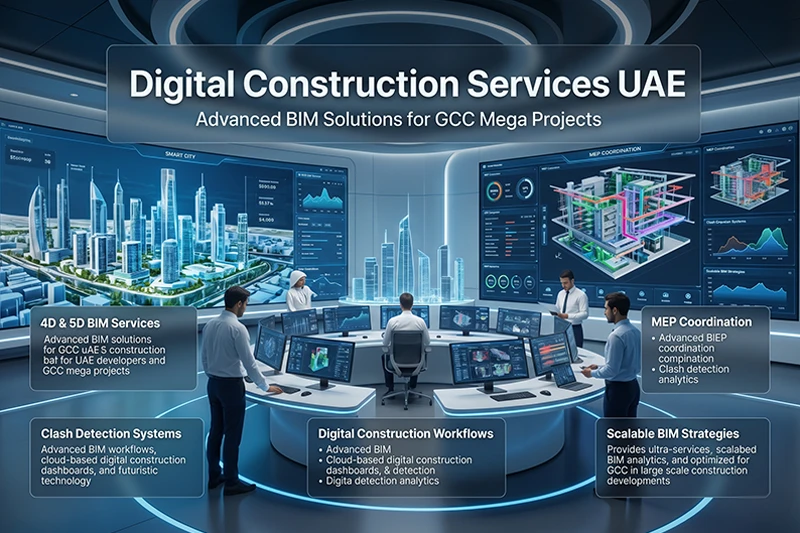
Building Information Modeling (BIM) is basically an absolute necessity for giga projects, as it creates one unified digital backbone. It connects tens of thousands of global stakeholders, helps avoid catastrophic design clashes, and keeps massive multi-billion-dollar budgets under control by simulating everything before a shovel actually hits the dirt.
Trying to execute a giga project like massive smart cities, transit networks, and regional developments across Saudi Arabia, and beyond, without BIM is almost impossible. This is why it becomes a non-negotiable lifeline for these monumental undertakings:
- Multi-Dimensional Simulation (3D to 7D) - Giga projects rely on Multi-Dimensional Simulation, like going from 3D all the way toward 7D, and they use advanced BIM dimensions to plan way past basic shape and lines:
- 4D (Scheduling) brings in time-series data to show the construction run, so logistics stay clean even across huge worksites.
- 5D (Cost) handles automated quantity takeoffs, and it can give real-time budget projection, basically cutting down on late surprises.
- 6D (Sustainability) digs into energy performance, material consumption, and carbon footprints, to help match the global green requirements without the usual guesswork.
- 7D (Facility Management) delivers a detailed digital twin for ongoing operations, upkeep, and building management, long after the build period wraps up.
- Radical Clash Detection and Risk Mitigation - When you are building miles of infrastructure, or those skyscrapers, even a small misalignment between mechanical, electrical, and structural layers can turn into millions in costs. With BIM, engineers can do automated collision checks inside the virtual model, which cuts down on expensive on-site redo, as it gets caught first, before construction really even starts.
- Streamlined Collaboration and Communication - For giga projects, you need a Common Data Environment, or CDE. Instead of relying on scattered, easy-to-misplace paper blueprint-style documents, BIM gathers everything into one centralized spot that people can actually get to. In that way, each contractor, architect, and other stakeholders can essentially view the same single source of truth, not bouncing between different versions, and not arguing about what’s current.
- Supply Chain Integration - BIM in the UAE construction industry lets modular construction happen, and also makes off-site prefabrication easier. When you map the exact tolerances digitally, global suppliers can produce materials with a lot of precision, then ship them to the site for pretty seamless assembly and less rework.
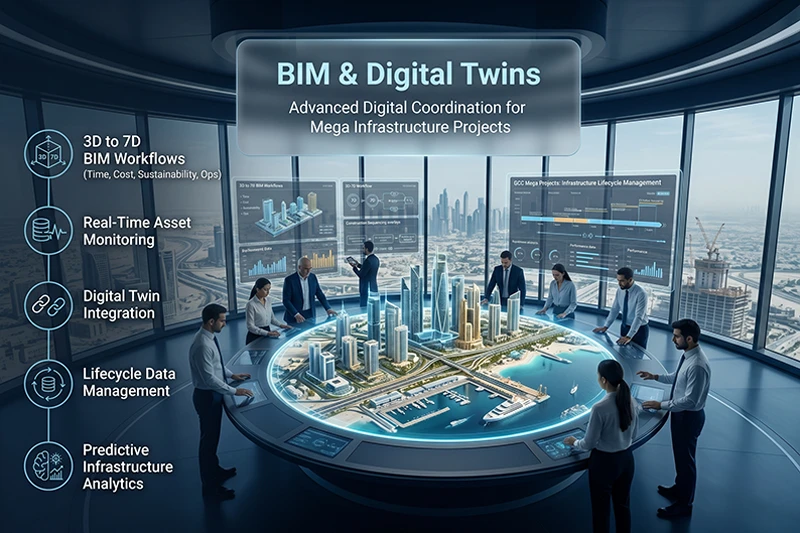
- Lifecycle Data Management - The benefit of BIM keeps going beyond the build phase. For long-term government or private projects, the digital twin in Saudi Arabia basically turns into a huge data store for renovations, repairs, and also for future scalability. It’s like an ongoing operational backbone rather than just a model that sits there.
The Advantages of BIM for mega projects in the UAE
Some of the key advantages of BIM in Saudi Arabia’s giga-project ecosystem include:
1. Advanced Coordination Across Different Disciplines - Mega projects usually have thousands of connected systems going on at once. With BIM coordination, architects, structural engineers, and MEP teams can keep working together more or less simultaneously, while also cutting down on design conflicts that show up later. And yeah, this ends up reducing expensive redo work and construction delays quite a lot, too.
2. Digital twins, real-time information - Mega-projects are increasingly leaning on digital twins in Saudi Arabia, which are basically live digital representations of physical assets. BIM acts like the backbone for these setups by linking geometry and operational data together, so it’s not just “pretty models” anymore. Project owners can track their assets across the entire lifecycle, and that helps with maintenance, sustainability, and day-to-day operational performance.
3. Quicker decisions, better responsiveness - BIM dashboards combined with cloud collaboration tools let stakeholders reach the latest project information right away without any delay. As a result, approvals move faster, procurement planning gets smoother, and site coordination stops feeling so slow
4. Sustainability and smarter infrastructure - Saudi Arabia’s Vision 2030 keeps pushing environmental responsibility forward. BIM in UAE construction industry supports using things like:
- Energy analysis
- Material optimization
- Carbon reduction strategies
- Waste minimization
- Lifecycle performance simulation
And projects such as NEOM are trying to set new sustainability benchmarks, using digitally integrated construction systems, which is kind of the idea behind this whole shift toward better engineered outcomes.
Challenges Saudi Giga Projects are Facing
Even if the opportunities are huge, these giga-projects still come with massive complexity. Some reports are saying that parts of NEOM have gone through scope changes, and there have also been budget pressures, mainly because the project scale is unprecedented, and it keeps expanding, like not really stopping.
Without BIM-led coordination, managing giga-projects becomes close to impossible. For developments at this size, you really need a set of capabilities that all work together, like
- Common Data Environments CDEs
- ISO 19650 alignment
- BIM execution planning
- clash detection that’s more advanced than usual
- 4D scheduling
- 5D cost integration
- cloud-based collaboration systems
In the end, the firms doing best in Saudi Arabia are usually the ones putting real money behind digital construction technologies, and not treating them like optional upgrades.
What UAE Developers Can Learn
So, the UAE has been pretty much a leader in inventive construction for a while now. Dubai and Abu Dhabi are already pushing BIM mandates and smart city stuff, that’s clear. But honestly, the big giga-project wave coming out of Saudi Arabia gives UAE developers a bunch of lessons worth keeping in mind, even if it feels a bit far away.
1. BIM Must Move Beyond Compliance
A lot of companies still treat BIM like it’s mostly paperwork. Like a documentation thing, you do it to satisfy rules. Yet the Saudi giga-projects show something else. BIM in Saudi Arabia, UAE is turning BIM into a real strategic business tool.
In the near future, the winners are companies that use BIM for things like
- Asset intelligence
- Predictive upkeep
- Construction automation
- AI integration
- Digital twin models
- Facility management support
2. Start BIM Early
One thing that keeps showing up with GCC BIM mega efforts is that BIM performs way better when it enters the process from the first design moments.
Developers who pull in BIM consultants during concept planning tend to get better constructability, lower lifecycle costs, faster approvals, and tighter stakeholder coordination. Early use of BIM saves construction time, avoids clash detection on huge projects before construction begins, and avoids construction rework.
3. Data handling is turning into the real edge
Construction is moving toward a data-centered model. So companies that can organize, manage, and analyze project information properly will usually outpace competitors who only focus on drawings and schedules
Additionally, ISO 19650-compliant workflows are becoming more important across the region, including the GCC.
4. Collaboration, not isolated workflows
Saudi Arabia’s giga-project environment runs on cooperative digital spaces. Global consultants and contractors are expected to work together smoothly across lots of moving parts.
The UAE developers can take advantage of integrated BIM collaboration systems that improve inter-team communication and reduce the fragmentation effect, where everyone builds their own version of reality, for a while.
The Growing Demand for BIM Services in the UAE
Right now, as Saudi Arabia keeps ramping up giga-project development, the demand for BIM know-how across the GCC is going up really fast. In the UAE, developers are looking more and more for specialized BIM partners who can manage complicated infrastructure, commercial setups, healthcare facilities, hospitality assets, and even mixed-use developments too
And this is where companies like Designheed UAE step in, helping shape what digital construction will look like going forward.
Designheed UAE offers ISO 19650-compliant BIM modeling, MEP coordination, clash detection, 4D & 5D BIM, Scan-to-BIM, and digital construction services for developers, consultants, and contractors across the UAE and the wider GCC. Their experience is meant to support quicker, higher efficiency delivery while reducing expensive coordination and rework.
As the region pushes for more advanced BIM workflows, UAE firms that set up scalable BIM strategies today will be in a stronger position to join upcoming giga-project work across Saudi Arabia and the rest of the GCC later on.
Conclusion
Saudi Arabia’s giga project surge is basically showing that BIM is now essential for pushing through complicated, big-scale developments more efficiently and in a more sustainable way. From NEOM BIM implementation to all those smart infrastructure programs, digital construction is really nudging the GCC toward what comes next.
For UAE developers, the takeaway feels straightforward: putting money into advanced BIM and Digital twin workflows in Saudi Arabia, better digital teamwork, and data-driven project steering will likely be the difference-maker if you want to stay competitive as the construction scene keeps shifting fast across the region. Companies like Designheed UAE are helping businesses to embrace this digital transformation across the whole UAE and GCC region.
Read More - BIM for Healthcare Facilities in UAE
Questions People Frequently Ask
Q1: What are giga-projects in Saudi Arabia?
Ans: Giga-projects are these huge, large-scale developments that Saudi Arabia rolls out under the Vision 2030 initiative. Basically, they’re meant to shift the economy, diversify revenue, and end up with more sustainable city ecosystems. In practice, you’ll see names like NEOM, Qiddiya, The Red Sea Project, and Diriyah Gate, which all come with that “build-it-fast and transform everything” vibe.
Q2: Why is BIM important for giga-projects?
Ans: BIM matters because these giga-projects, given that they are enormous projects, are insanely complex. So BIM helps the teams line up all the different disciplines, it cuts down clashes, and it also makes collaboration feel more immediate and organized. On top of that, it supports sustainability checks and helps with lifecycle asset management, so the model isn’t only “for design,” it keeps being useful later on.
Q3: How is BIM used in NEOM?
Ans: NEOM uses BIM in a pretty broad way: multidisciplinary coordination, smart infrastructure planning, and digital twins. They also do sustainability analysis and use data-driven construction management to keep construction decisions linked to the futuristic urban vision instead of being random or slow.
Q4: What can UAE developers learn from Saudi Arabia’s giga-projects?
Ans: UAE developers can take a lot from how Saudi Arabia is approaching giga-projects. The big points are early BIM adoption, integrated collaboration systems, and ISO 19650 workflows. Also, the lesson is to use BIM not just for ticking boxes, but more as a strategic tool for smarter asset management and smoother project delivery.
Q5: What services does Designheed UAE provide?
Ans: Designheed UAE provides BIM modeling, MEP coordination, clash detection, scan-to-BIM, 4D & 5D BIM, construction documentation, plus ISO 19650-compliant digital construction solutions. They cover work across the UAE and the GCC region, so it’s not just one local niche.