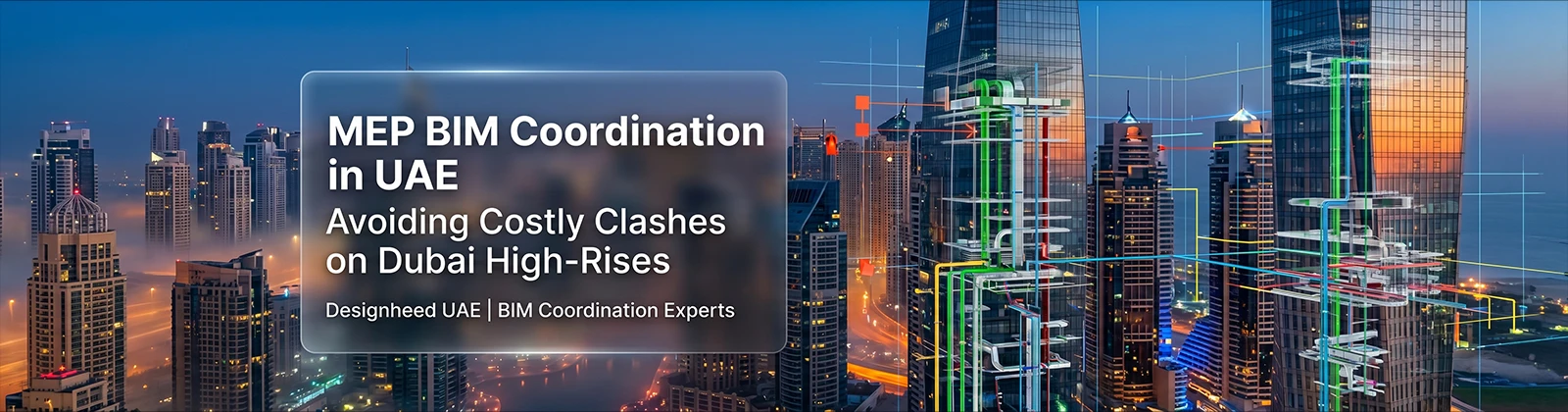
The architectural ambitions of the United Arab Emirates, especially Dubai, are displayed through its multiple high-rise buildings. The projects require precision throughout their execution process, which includes both their extremely high towers and their intricate combined-use construction work. The MEP BIM Coordination process for UAE construction projects serves as the main element that guarantees the correct operation between mechanical systems, electrical systems, and plumbing systems.
The most famous high-rise buildings need the right management to prevent expensive project disruptions, which include clashes, construction delays, and work that needs to be redone. The advanced MEP BIM Services in UAE help developers, contractors, and consultants to build efficient buildings that do not experience clashes.
Why MEP Coordination Is Crucial in Dubai High-Rise Buildings
High-rise buildings show greater construction difficulties than ordinary buildings. The industry report shows that building systems, which include ducts, pipes, and cable trays, will create spatial conflicts when they reach their maximum operational capacity.
In Dubai, the experience of fast-paced construction projects can lead to operational problems because of insufficient project coordination.
- System clashes between HVAC, plumbing, and structure
- Project delays and budget overruns
- Rework that significantly increases costs
- Compliance and safety issues
The architectural design requires more advanced solutions than traditional 2D drawings can provide. MEP BIM Coordination has transformed into an essential process that organizations must implement for their operations.
Common MEP Challenges in UAE Construction
The current construction technology progress fails to resolve MEP (Mechanical, Electrical, and Plumbing) coordination problems that continue to exist within the United Arab Emirates. The resulting problems create expensive project delays, which require additional work and operational downtime.
- Spatial Clashes - High-rise buildings experience spatial clashes because their service systems require dense routing through their structures. The absence of Building Information Modeling (BIM) results in late identification of problems, which leads to costly rework and project delays.
- Poor Communication Between Teams - Architects, engineers, and contractors create project silos, which prevent them from working together effectively. The absence of communication creates inconsistencies between teams, which results in work disruptions throughout the project.
- Frequent Design Changes - The whole MEP system experiences major effects from design changes that happen during the final stages of development. The required changes lead to project team members needing to spend extra time on redesigning and coordination tasks, which results in project delays and increased expenses.
- Lack of Visualization - MEP systems require advanced display methods because traditional 2D drawings fail to show their intricate spatial relationships. The absence of advanced visualization tools creates challenges for identifying potential conflicts, which result in expensive, urgent changes.
- Time Constraints - Dubai's fast-track projects demand urgent work because the city needs to complete construction projects. The restricted time period for correcting mistakes on-site increases the chance of making errors, which makes it essential to solve coordination problems before work begins.
- Governance and Workflow Challenges - The main reason for BIM implementation failure is that organizations fail to create proper project plans and assignment systems, and their teams lack established procedures for working together. Many construction professionals believe that inadequate governance and undefined workflows create the main problems that organizations experience with BIM implementation, instead of software technical limitations.
How BIM Prevents Costly Clashes in Dubai High-Rises
Dubai high-rise construction projects use Building Information Modeling (BIM) as their main tool to avoid expensive MEP conflicts that arise from their complex architectural designs and fast project schedules. The developers use BIM to create advanced planning systems that enable them to detect potential project problems before they escalate into major budget and timeline issues.
1. Advanced Clash Detection - The MEP BIM services in the UAE provide their strongest benefit through their automated clash detection system. The Autodesk Revit and Autodesk Navisworks tools enable users to detect system conflicts, which include:
- HVAC system interferes with structural elements
- The electrical system interferes with plumbing systems
- Vertical shaft areas that experience system congestion
The design phase should handle these problems because it helps to avoid costly changes that need to happen during construction work. High-rise buildings require early clash detection because one conflict that appears through 30 floors will create massive financial costs.
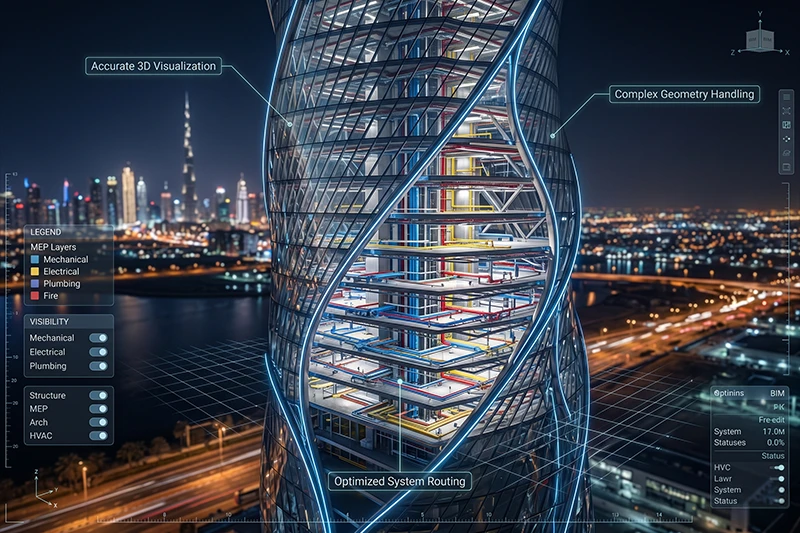
2. 3D Visualization for Complex Geometry - The Dubai skyline displays its famous architectural design through buildings that include rounded walls and expansive indoor spaces, and their unique building shapes. BIM provides teams with precise tools to visualize MEP system integration throughout intricate building designs.
The process creates:
- Spatial planning improvements
- Architectural intent preservation
- System routing optimization, which increases operational efficiency
The complete project picture enables teams to make construction plans because it eliminates uncertainty and decreases project risks.
3. Improved Collaboration Across Stakeholders - Traditional construction workflows face difficulties because their communication processes maintain multiple separate channels of contact. The BIM system establishes a unified digital workspace that enables architects, engineers, and contractors to work together on a shared 3D architectural design.
The process produces these outcomes:
- Faster and more informed decision-making
- Reduced miscommunication between disciplines
- Smoother and quicker approval processes
The construction industry demonstrates through its practical experience that BIM-based team collaboration improves project performance while decreasing project delays.
4. Cost and Time Savings - The construction projects in the UAE face major expenses because rework is their primary cost driver. The implementation of BIM technology reduces costs through its ability to detect and solve disputes during the initial project stages.
The main advantages of this project are:
- Significant reduction in rework costs
- Improved construction sequencing
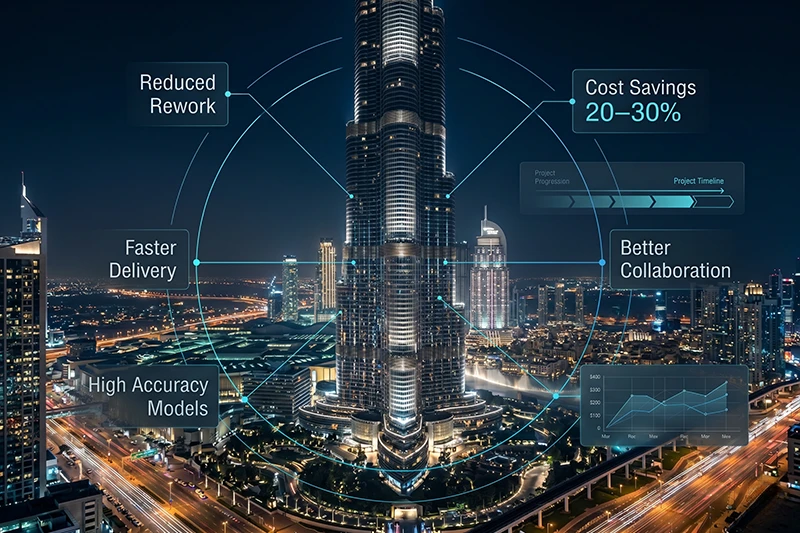
- Potential overall project cost savings of up to 20–30% through better coordination
The cities of Dubai, Abu Dhabi, and Sharjah now treat MEP BIM services as essential strategic investments instead of discretionary budget items.
5. Integration with 4D and 5D BIM - Modern BIM extends beyond 3D modeling to include time and cost dimensions:
- The 4D BIM system combines project scheduling with 3D building information modeling.
- The 5D BIM system uses building information modeling to estimate costs and create budgets.
Developers and project managers gain this capability through the system:
- Real-time construction schedule tracking
- Budget forecasting and management
- Prevention of unplanned financial and schedule disruptions
Role of Designheed UAE in MEP BIM Excellence
Designheed UAE functions as an MEP BIM service provider that establishes its credibility through effective MEP BIM services in Dubai.
The company specializes in
- High-rise MEP coordination
- Clash detection and resolution
- Revit-based modeling
- Code-compliant design solutions
Designheed UAE ensures that projects are executed with precision, minimizing risks and maximizing efficiency. The company uses advanced workflows to assist clients in meeting strict deadlines while preventing expensive mistakes that occur in fast-paced, competitive markets.
Best Practices for Effective MEP BIM Coordination
The UAE developers should utilize strategic MEP BIM coordination, which helps them avoid expensive clashes while achieving smooth project delivery. The following best practices can significantly improve efficiency and project outcomes:
1. Early BIM Implementation - The design stage requires BIM coordination to start, while construction work needs to begin. The teams need early implementation because it helps them find and solve potential problems before they become expensive field problems.
2. Use of Federated Models - The project uses a single federated model to merge architectural, structural, and MEP models, which creates an overall project representation. The method helps with project coordination because it improves accuracy and maintains discipline connections throughout all project stages.
3. Regular Clash Detection Workshops - The team needs regular meetings and clash detection sessions because these help them identify and solve problems before design work begins. The sessions enable teams to analyze design conflicts while establishing design priorities and maintaining design progress through the project.
4. Hire Experienced BIM Coordinators - The work of an experienced BIM coordinator involves handling model integration processes while maintaining industry standards and meeting local regulatory requirements. Their expertise helps streamline workflows and reduces the risk of coordination errors.
5. Adopt Smart Building Integration - MEP systems in Dubai and Abu Dhabi cities now face increased complexity because smart buildings are becoming more common. The integration of IoT-enabled systems and smart technologies with BIM workflows provides organizations with enhanced system performance and increased ability to accommodate future requirements.
Conclusion
The MEP BIM Coordination system in the UAE serves as the essential component that enables the successful construction of high-rise buildings in this area, which has high architectural aspirations. It transforms complex high-risk projects into predictable and efficient developments that maintain fixed budget costs.
The message for developers who plan projects in 2026 is clear. The implementation of MEP BIM services in the UAE presents developers with benefits that extend beyond conflict resolution to create efficient and environmentally friendly building processes.
Questions People Frequently Ask
Q1. Is BIM mandatory for MEP submissions in Dubai?
A: The Dubai Municipality requires major projects to submit MEP drawings through BIM for approval. The DEWA approval process includes electrical drawing evaluation and load schedule assessment.
Q2. What types of clashes does MEP BIM coordination detect?
A: BIM coordination detects three types of clashes, which include hard clashes, soft clashes, and workflow clashes. The most common on UAE high-rises are between HVAC ductwork and structural elements, and between electrical trays and plumbing pipelines.
Q3. Which software is typically used for MEP BIM coordination in the UAE?
A: Autodesk Revit serves as the main modelling software for MEP design work in the UAE. The industry commonly uses Navisworks to perform clash detection and conduct model evaluations. Project teams use BIM 360 Autodesk Construction Cloud for their cloud-based collaboration needs.
Q4. At what stage of a project should MEP BIM coordination begin?
A: The MEP BIM coordination process should start at the schematic design stage, which represents the earliest project stage. The earlier conflicts are detected, the cheaper they are to resolve. The cost of coordination work increases dramatically when projects reach their detailed design and construction phases.
Q5. Does Designheed UAE provide MEP BIM services across the GCC, including Riyadh?
A: Designheed UAE provides MEP BIM services throughout the GCC region, which includes Riyadh. Designheed UAE provides MEP BIM services in Dubai, MEP BIM services in Abu Dhabi, MEP BIM services in Sharjah, and MEP BIM services in Riyadh. The team has experience across residential towers, mixed-use developments, commercial buildings, and hospitality projects throughout the UAE and Saudi Arabia.